


The yoke sweater is one of the most recognisable shapes in knitting: a plain body and sleeves, with a ring of colourwork around the neck and shoulders. It looks old and traditional, and a lot of knitters link it with Iceland, Scandinavia or Shetland, but most of the yoke patterns out there today are fairly new.
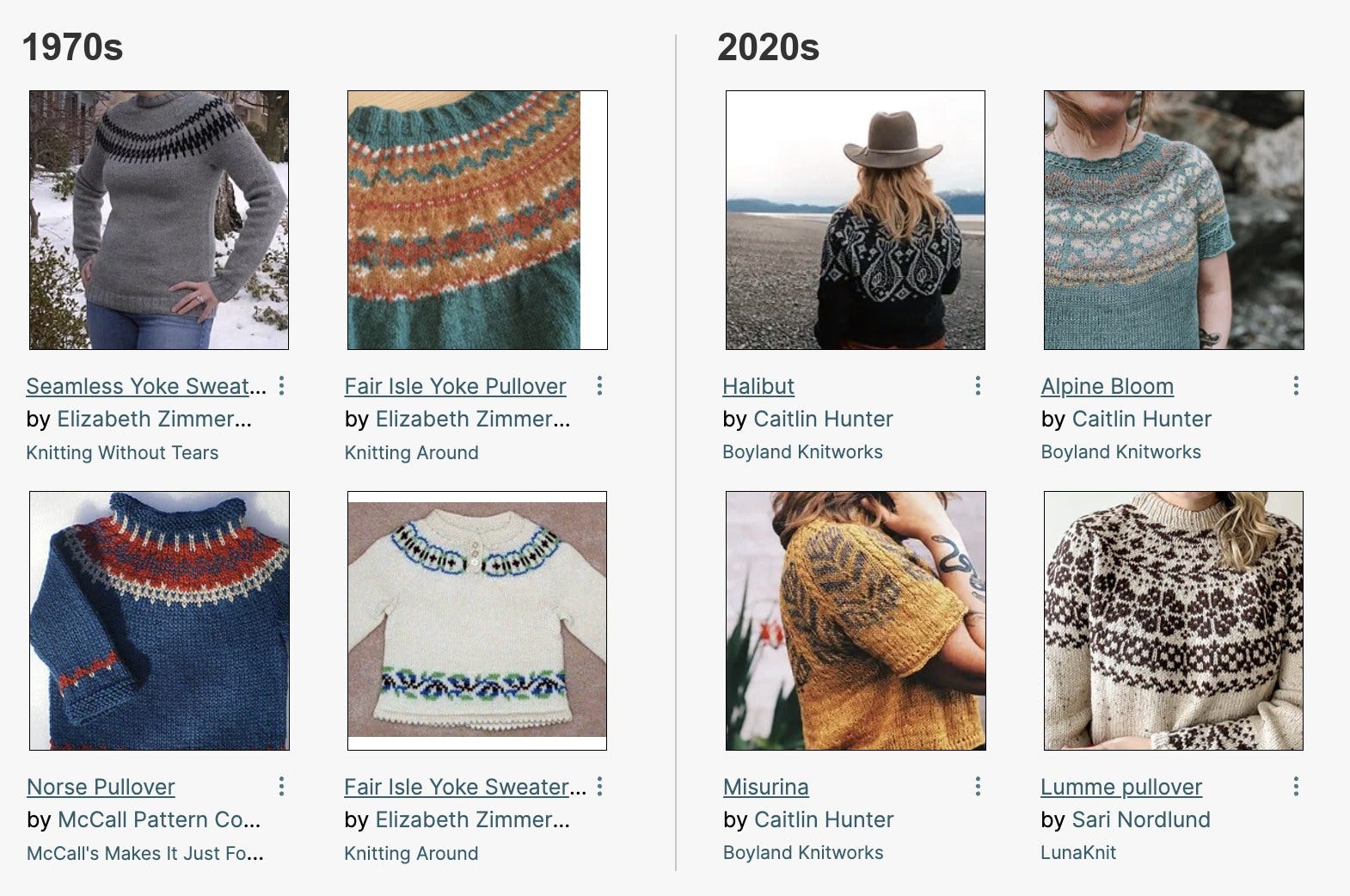
While I was looking through old yoke patterns for this series, I noticed how different they are from the yokes I see now. On most of the older ones, the colourwork is a narrow band of small patterns that stops well above the bust, and the sweater was knitted bottom-up, starting at the hem. Most yokes published in the last few years are knitted top-down instead, starting at the neck, with colourwork that often runs all the way to the underarm.
This is the third post on the circular yoke. The first was about the round yokes on ordinary 1930s sweaters, and the second about the Norwegian designer Annichen Sibbern’s 1930 “Eskimo” sweater, most likely the first circular yoke, and the yokes designed after it in Sweden, Iceland and Shetland. Here I pick the story up in the English-speaking world from the 1960s: why there are so many more yoke patterns now, how yokes came to be knitted top-down, and why yokes are now designed so much deeper.
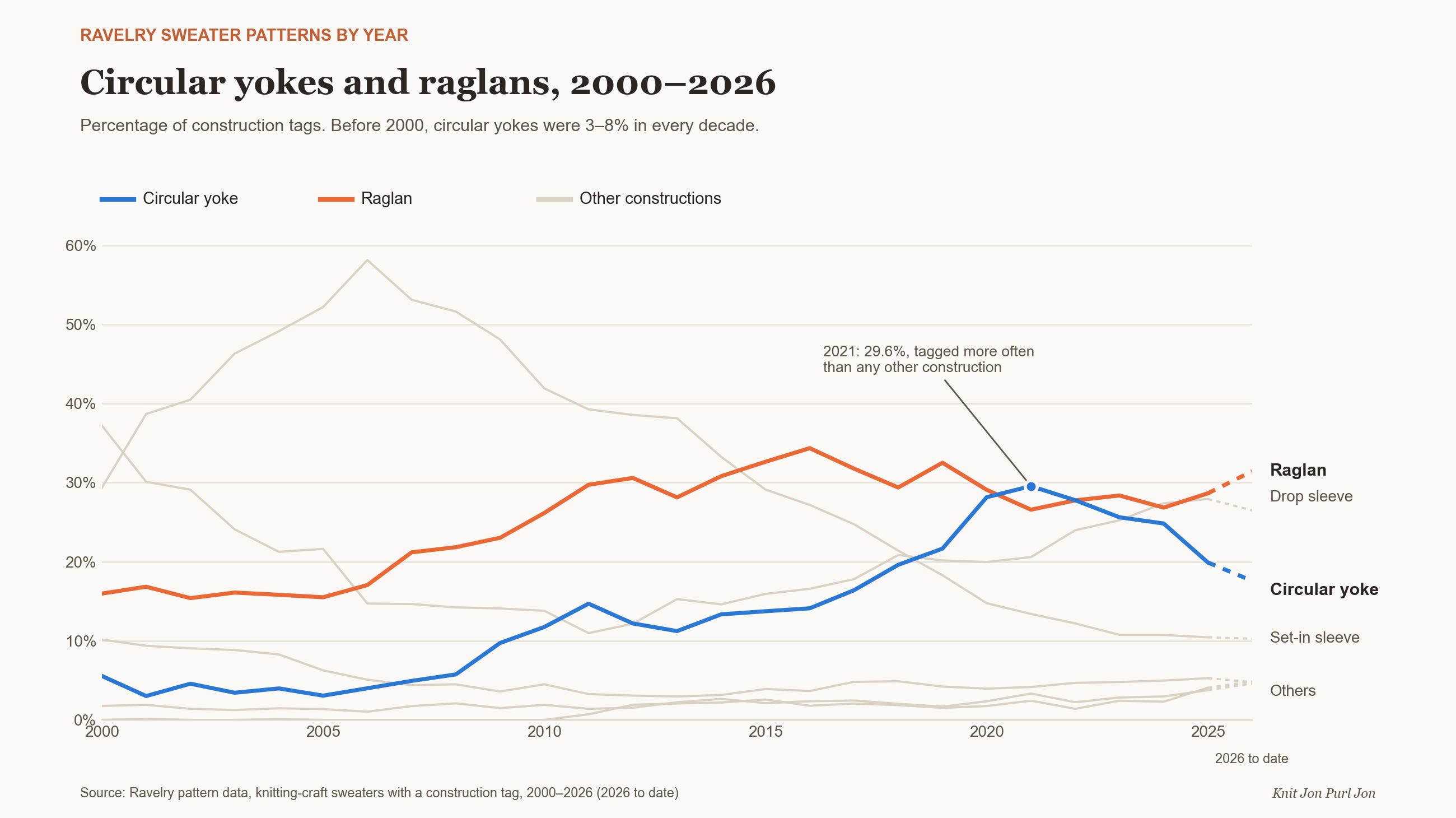
Yoke patterns are far more common than they used to be. From the 1930s to the 2000s, circular yokes made up 3–8% of the sweater patterns on Ravelry tagged with a construction (raglan, set-in sleeve and so on). Most of the increase is in patterns published after 2007, the year Ravelry was launched: the figure went from 5% in 2007 to 30% in 2021, ahead of the raglan (27%), and has since dropped back to 20% (in 2025), behind the raglan (29%) and the drop sleeve (28%). The numbers come from the same Ravelry data as 90 Years of Sweater Styles, and there’s more on how I counted at the end.
By the middle of the 20th century, most English-language sweater patterns were written to be knitted flat, in pieces, and sewn together, and most of the 1930s yokes from the first post were added to sweaters made that way, with set-in sleeves. Many people are surprised to find out that knitting in the round is likely much older than knitting flat. Stockings and mittens were knitted in the round for centuries, and so was the gansey, the fishermen’s sweater of the British and Dutch coasts, bottom-up and without a single seam. Over the whole history of knitting, I’d almost call the flat, sewn-together sweater a blip.
Elizabeth Zimmermann is the knitter best known for bringing seamless knitting back to English-speaking knitters. She was born in London in 1910 and moved to the United States in 1937, and in Knitting Without Tears (1971) she describes how she came up with her own seamless yoke. When her children were small, they “started agitating for yoke sweaters, which were then just coming into style”, so she knitted the body and sleeves in the round up to the underarm, joined them all on one circular needle, worked “a row of rather banal hearts around the whole yoke”, and went on holiday, leaving the unfinished sweater in the local knit shop. By the time she got back, three of the regulars were copying it. Like most yokes of the time, hers were knitted bottom-up.
She had less luck with her Fair Isle Yoke Sweater, designed in 1956. She wrote it to be knitted entirely on circular needles and sold it to a yarn company, which printed it on the cover of one of its pamphlets with flat pieces in place of her seamless instructions. In her own words, reprinted in The Opinionated Knitter: “Magazine editors frequently impose their own knitting theories upon the helpless freelancer. So I said to myself, dammit, I’ll put out my own directions in my own newsletter, free to wool customers, 25¢ to everyone else.” She mailed the first newsletter, with the Fair Isle Yoke Sweater as she’d written it, in September 1958, and the newsletters were later renamed Wool Gathering.
For decades after that, most yoke patterns were written bottom-up, like hers: from the 1970s to the 2000s, 61–77% of the yoke patterns on Ravelry in each decade are tagged that way.
Top-down knitting in English is most associated with Barbara Walker, who published Knitting from the Top in 1972. It’s a book of twelve basic designs, all knitted top-down: raglan pullovers and cardigans, a set-in sleeve, a saddle shoulder, skirts and even trousers. Walker explains every design in words rather than numbers, so you can work it out from your own measurements, and she’s upfront about why: “Personally, I don’t much care for numbers. They make me sleepy.” She also had a theory about why top-down knitting was thought to be difficult: the idea had been spread, she wrote, “not by knitters, but by instruction-writers”, because top-down directions are harder to write in the usual knit-by-numbers style.
Some of what’s in the book had been done before. Walker mentions that some knitters thought top-down knitting meant “just one thing: a seamless raglan sweater”, and top-down yokes were already more than forty years old: Sibbern’s 1930 “Eskimo” sweater, a 1930s Minerva Yarns blouse with a round yoke band and the Icelandic Grænlenzk peysa of 1956 were all knitted top-down. Walker gives the round yoke one paragraph, as a variation on the raglan, “such as those seen in the popular Icelandic sweaters”. Other parts were new, like her top-down set-in sleeve, “presented perhaps for the first time”. What Walker gave English-speaking knitters, most of whom were knitting flat and bottom-up, was one method they could use to knit almost any sweater top-down.
Even so, few yoke patterns were written top-down for a long time after the book: 1% of the yoke patterns on Ravelry from the 1970s and 14% of those from the 2000s, then 45% in the 2010s and 77% in the 2020s.
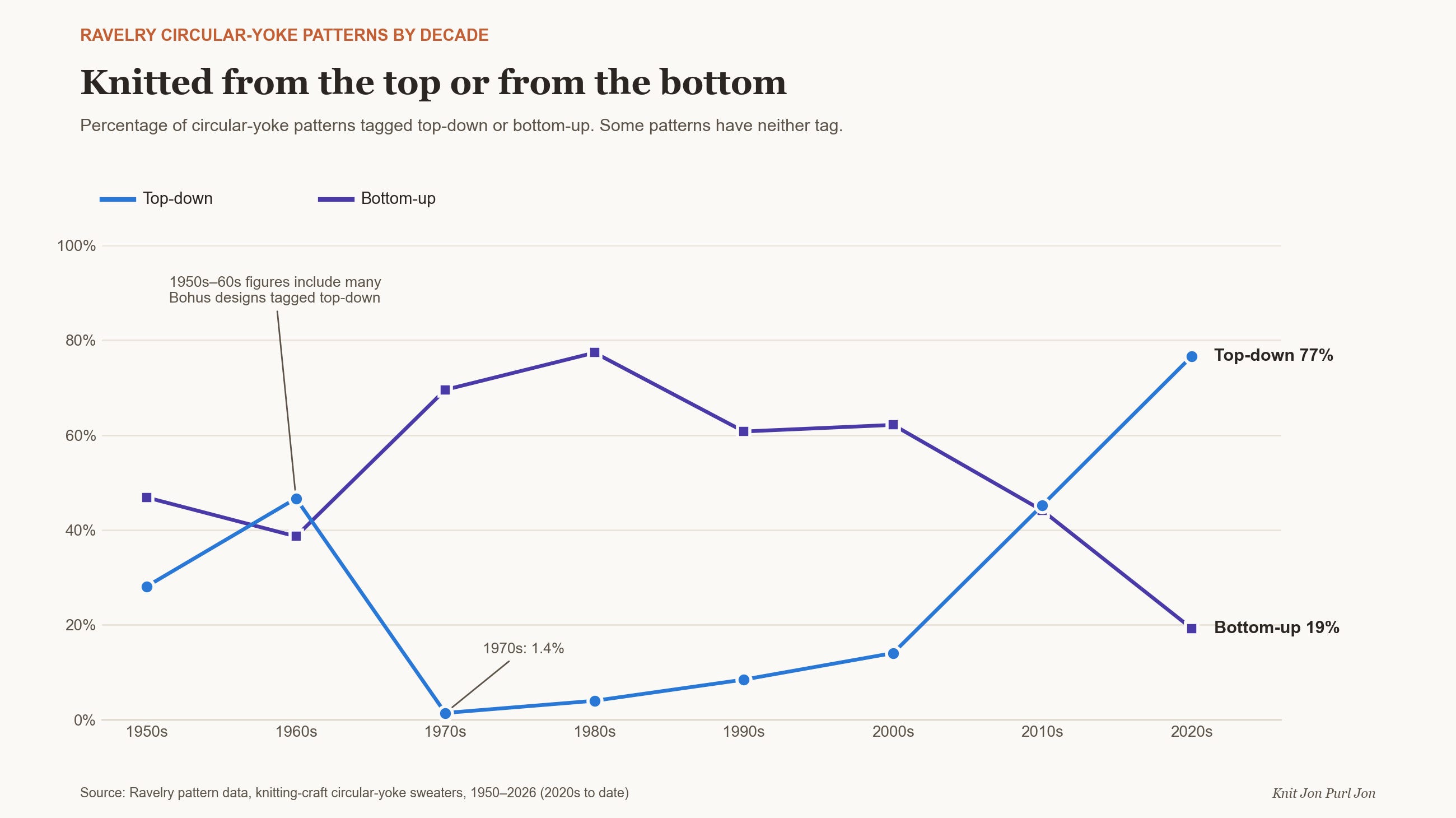
Why it took so long is my own reading, since the data can’t show it. Knitting top-down means you can try the yoke on as you go and decide the length of the body and sleeves at the end, once you can see how it fits (or how much yarn you have left). Walker made exactly that case in 1972, so I think the long wait had more to do with who was publishing patterns, and Walker and Zimmermann both pointed the finger at much the same people: instruction-writers and magazine editors. Until the 2000s, most English-language patterns came from yarn companies and magazines, which probably stuck to what their editors and customers already knew. In the 2000s more designers started publishing their own patterns, first free online in places like Knitty (from 2002) and then, from the late 2000s, selling them directly on Ravelry. Over the same years, the percentage of yoke patterns written top-down went from 17% in 2007 to 74% in 2020.
There’s another reason I think designers published so many yokes (and raglans) in the 2010s, whether they’re knitted top-down or bottom-up. Their shaping is fairly formulaic: a yoke is shaped with increases or decreases spread evenly around it, a raglan along four lines, and the same method can be used in every size. Grading a set-in sleeve means working out the armhole and the sleeve cap separately for each size so that they still fit together, and across a long list of sizes that maths can be daunting. Patterns are now often published in more sizes than they used to be, and I think the more intuitive grading is part of the appeal.
Ravelry has no tag for yoke depth, so to check what I’d noticed, I went through the main photos of the colourwork yoke patterns decade by decade, noting where the colourwork stops. Shallow means it ends at the upper chest, medium around the bust or armpit, and deep at or below the underarm.
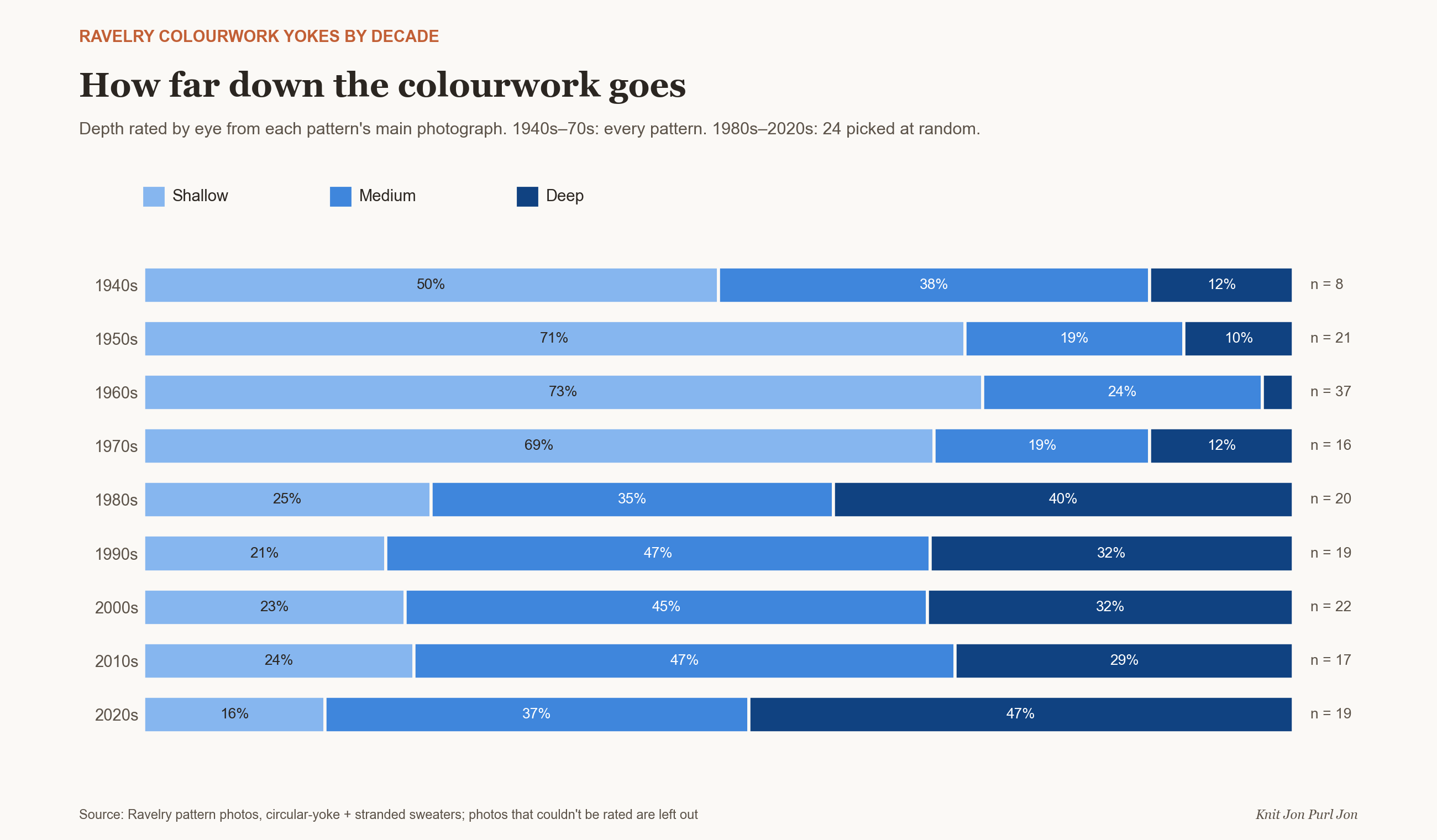
From the 1950s to the 1970s, about 70% of the yokes I looked at are shallow, and at most 13% are deep. Almost half of them are Bohus Stickning designs (now sold as kits), and most of the rest are from British and American yarn-company leaflets. Both groups are mostly shallow, and so are nearly all the British leaflets sold as “Fair Isle” yokes, like this one from Templetons.
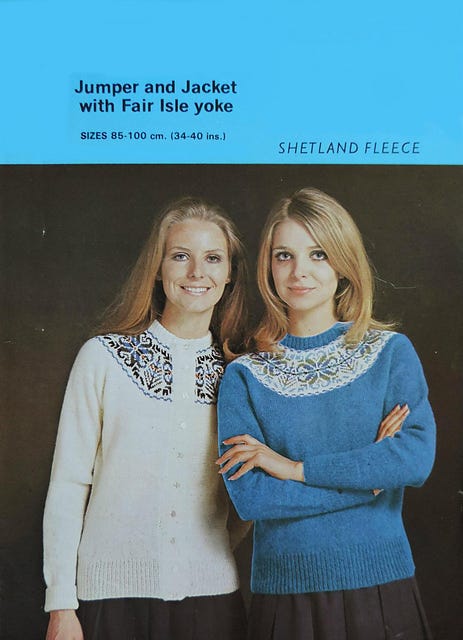
There may have been a practical reason for this, at least in Shetland. In the 1950s and 1960s, many Shetland yoke sweaters were made in two stages, often by different home workers: the plain body on a hand-operated knitting machine, and the Fair Isle yoke by hand. If the yoke is the slow, hand-knitted part of a sweater made to sell, I can see why you’d keep it shallow.
Deep yokes aren’t new, though: 40% of the 1980s yokes I looked at are deep, mostly Icelandic lopi designs, many of them from the Álafoss mill, so the lopapeysa was the first deep yoke to be published in large numbers. The figure then drops back to about 30% for three decades and reaches 47% in the 2020s, the highest of any decade, while only 16% of the 2020s yokes are shallow, so deep is now the most common depth for a colourwork yoke.
It’s clearer still if you look at what Ravelry users have knitted. The number of projects on a pattern is a rough measure of that, and of the 12 colourwork yokes with the most projects from each decade, 3–5 are deep from the 1980s to the 2000s (mostly lopi again), 7 in the 2010s, and 9 in the 2020s, most of them by a few well-known independent designers such as Caitlin Hunter, Andrea Mowry and Jennifer Steingass.
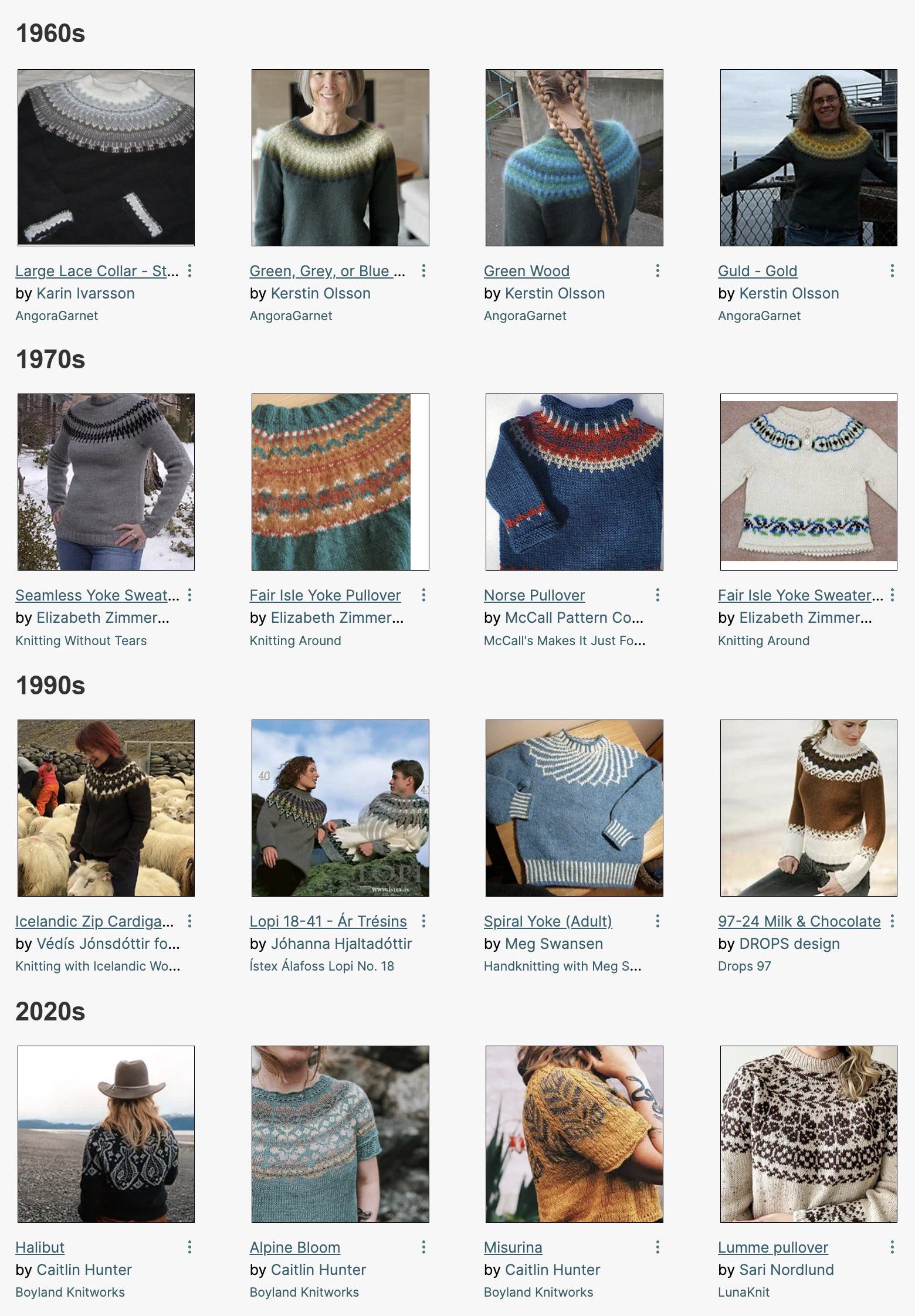
As for why, my reading is that there’s more room for the motif on a deep yoke. A yoke that stops at the upper chest has space for a few bands of small patterns, like the Shetland yokes of the 1960s. One that reaches the underarm has space for big motifs: leaves, trees, flowers and, in the last few years, a surprising number of fish, all of which can still be made out in a small photo on a phone screen.
So the yoke most of us knit today, in the round and top-down, is closer to Sibbern’s 1930 sweater than to the bottom-up yokes of the 1980s. I think the colourwork is part of why yokes look so much older than they are. Stranded colourwork is graphic enough that motifs from other crafts can be carried over easily, as Sibbern did with a beaded Greenlandic collar and the Bohus designers did with woven patterns, and on a deep yoke there’s room for more of them. (I wrote about newer garments being given older stories in Why Sweaters Need Myths.)
Next week’s post, for paid subscribers, is about the yoke sweaters I’ve knitted myself: how I made them, and what I liked and didn’t. If you’ve knitted a yoke, I’d love to hear which depth you went for, and whether you knitted it top-down or bottom-up.
How I counted. The figures are Ravelry pattern counts by the year each pattern was first published, as in 90 Years of Sweater Styles. Construction tags are added by whoever enters a pattern, a bit like a wiki, and about half of sweater patterns have none, so the percentages are of construction tags (a pattern with two tags counts twice). The number of tags per pattern held steady from 2021 to 2026, so the recent fall in yokes isn’t down to newer patterns going untagged. Before the 1980s there are fewer than 100 yoke patterns per decade, so those percentages are based on a handful of patterns. Reissued designs such as the Bohus kits are dated to their original decade, although their tags may have been added for the reissue, which is why the top-down figures for the 1940s to the 1960s may be higher than you’d expect.
For depth, I rated every stranded colourwork yoke from the 1940s to the 1970s (fewer than 50 per decade), and for later decades 24 picked at random plus the 12 with the most projects, leaving out close-ups, back views and all-over colourwork. Most projects were logged after 2007, so for the older decades the most-knitted patterns are the ones people knit now, not necessarily the ones knitted at the time. One photo per pattern is a rough way to judge depth, since a yoke can look deeper or shallower depending on the pose, the fit and the camera angle, and with 8–37 photos per decade, small differences could be chance. I’d like to redo this one day with bigger samples, but 281 photos by eye was already plenty for one post.
Further Reading
Lynn Abrams and Lin Gardner, “Recognising the Co-dependence of Machine and Hand in the Scottish Knitwear Industry,” Textile History 52 (2021): Shetland yoke sweaters made with machine-knitted bodies and hand-knitted yokes.
Barbara G. Walker, “Knitting from the Top” (1972): top-down construction as a general method, with twelve basic designs.
Elizabeth Zimmermann, “Knitting Without Tears” (1971): her seamless yoke sweater, designed when yoke sweaters were “just coming into style”.
Elizabeth Zimmermann, “The Opinionated Knitter” (2005): the Fair Isle Yoke Sweater published in flat pieces, and the start of her newsletters.
Very interesting to see the data! I'm a big fan of top-down, and can confirm that, yes: they are more of a challenge to write and grade, especially for a top-down, contiguous, set-in sleeve sweater since there is so much going on in the various sizes. But hey--that's why they pay me the big bucks $$ :)
I wonder, though, why yokes are so exaggeratedly deep. It's not only for the sake of patterning (and it is, of course, possible to knit a patterned sleeve). Just take a look at the models in Ozetta's oversized sweaters with their arms pressed to their bodies to hide that they are wearing swonchos.