


This week’s a bit different: here are six charts I made while digging into almost a century years of sweater pattern data. I got curious about how sweater construction has actually shifted over the decades, and wanted to see what the numbers showed
Sweater patterns on Ravelry can be tagged with a sleeve construction: raglan, set-in sleeve, drop sleeve, circular yoke, and a few less common ones. Those tags are added by whoever enters the pattern into the database, not by Ravelry itself and not necessarily by the designer, the same way anyone edits a wiki entry. Ravelry’s search also records the year a pattern is first published, so patterns can be counted by tag and year and compared across time.
About half of sweater patterns on Ravelry have no construction tag at all, so every percentage below describes tagged patterns only, not all sweaters, and a published pattern is also not the same thing as a popular one. In the earliest decades, most of what’s in the database was added because someone happened to catalogue a vintage pattern years after the fact, and Ravelry’s userbase skews English-speaking and Western, which likely affects which patterns appear in the database at all. Read what follows as a rough sketch, not a survey.
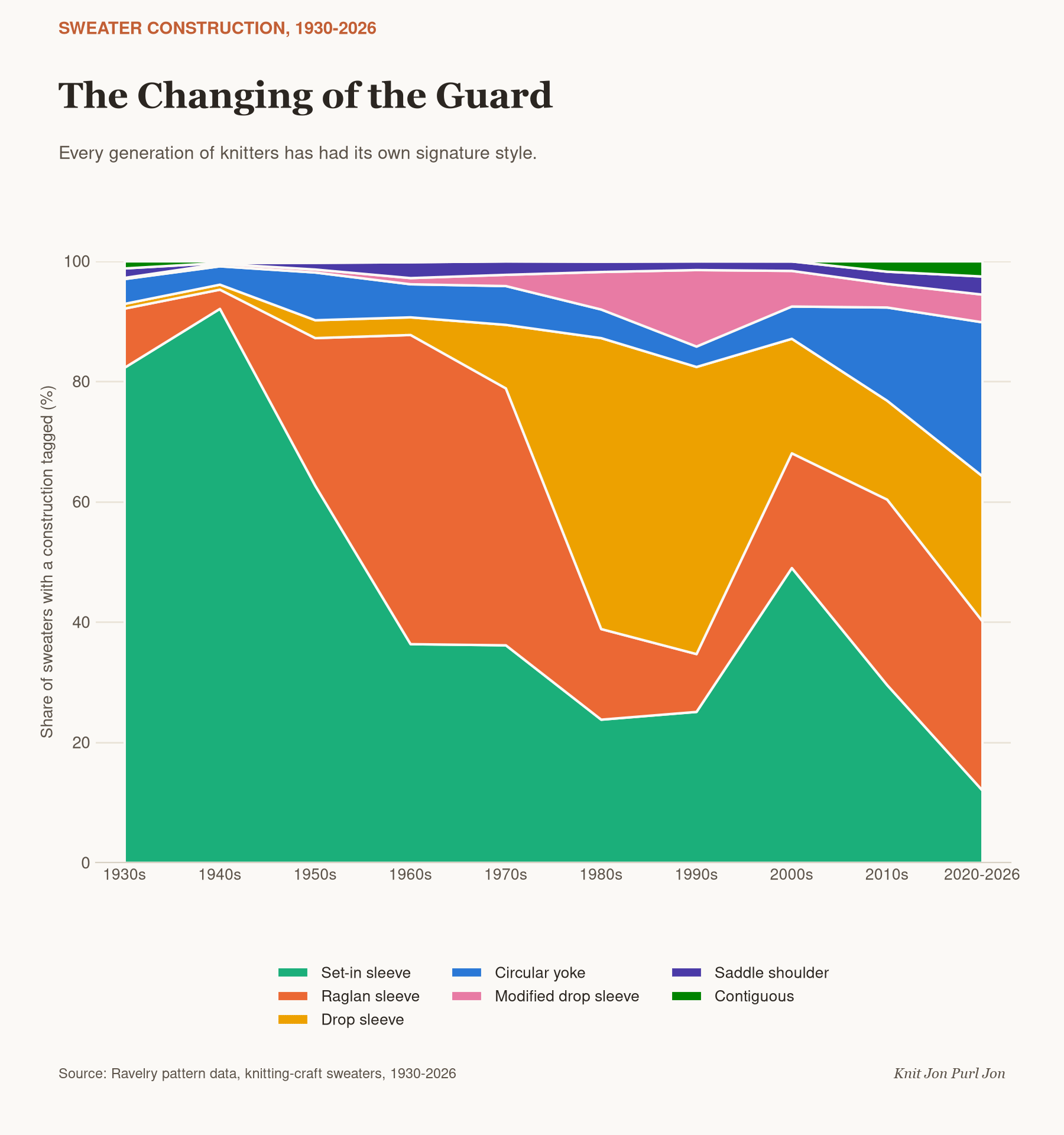
Across seven constructions and 96 years, no single construction has remained the most common for more than about twenty consecutive years. The clearest feature of the chart is how much of its right-hand edge is occupied by styles that were negligible a generation ago. A knitter who’s been at it for thirty or forty years has likely lived through more than one of these changes and may have felt a disconnect between what they’re comfortable knitting and what patterns are out there.
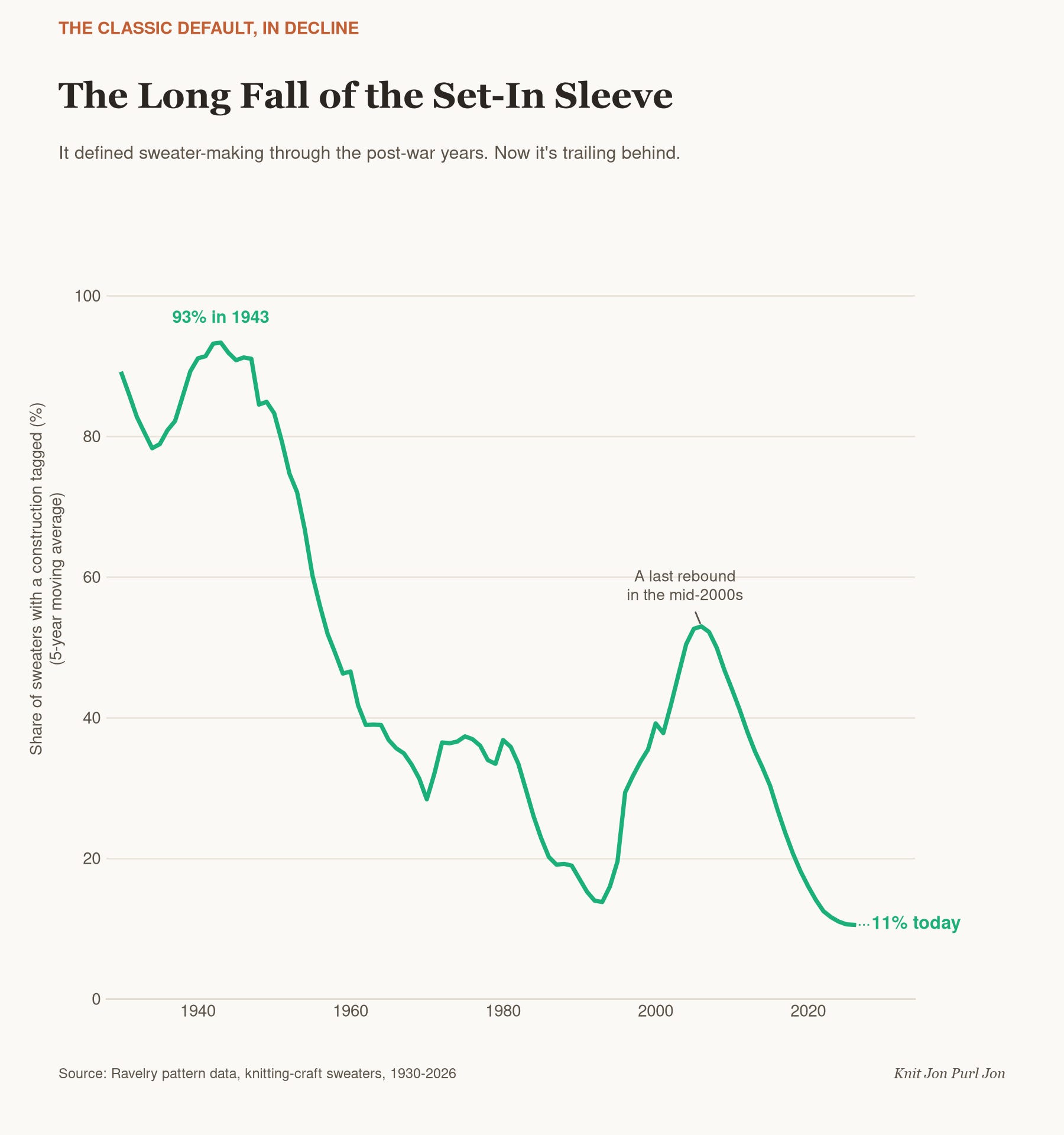
Set-in sleeve is the construction behind a tailored jacket, sewn in a curve to match a curved armhole. Despite its dominance in earlier decades, it isn’t the oldest or most “traditional” way to build a sweater. Older, simpler shaping was quite different: a drop shoulder often required no shaping at all, or sometimes there was an armhole gusset added instead, the kind of construction found on ganseys and other older working garments. Those garments were typically knit in the round too, which may surprise some people. Set-in sleeve is essentially the tailoring approach applied to hand knitting, and many vintage patterns share a standard workflow that knitters either love or hate: you knit 4 (or 5, if it’s a cardigan) separate pieces with shaping, sew them together, and see how it fits.

This construction came alongside the rise of commercial pattern publishing: companies like Weldon’s and Patons had been standardizing printed knitting instructions since the early 1900s, at a point when sweaters were still a fairly new everyday garment, and those patterns borrowed their shaping conventions from dressmaking rather than from older, garment-specific knitting traditions. Wartime knitting campaigns pushed that publishing culture further still, and the tailored, close-fitting silhouettes of the 1940s, 50s and 60s suit set-in sleeve shaping perfectly.
Of the tagged patterns dated to the 1940s, over 90% are set-in sleeve, which matches my own experience flipping through vintage patterns from that era. There’s an unexplained rise again in the mid-2000s that I haven’t been able to work out, so if you have any idea what might explain it, I’d love to know. What isn’t in question is the endpoint: set-in sleeve is now the least common of the major constructions among tagged patterns, though there’s a bit more to the story than that, which we’ll get to below.
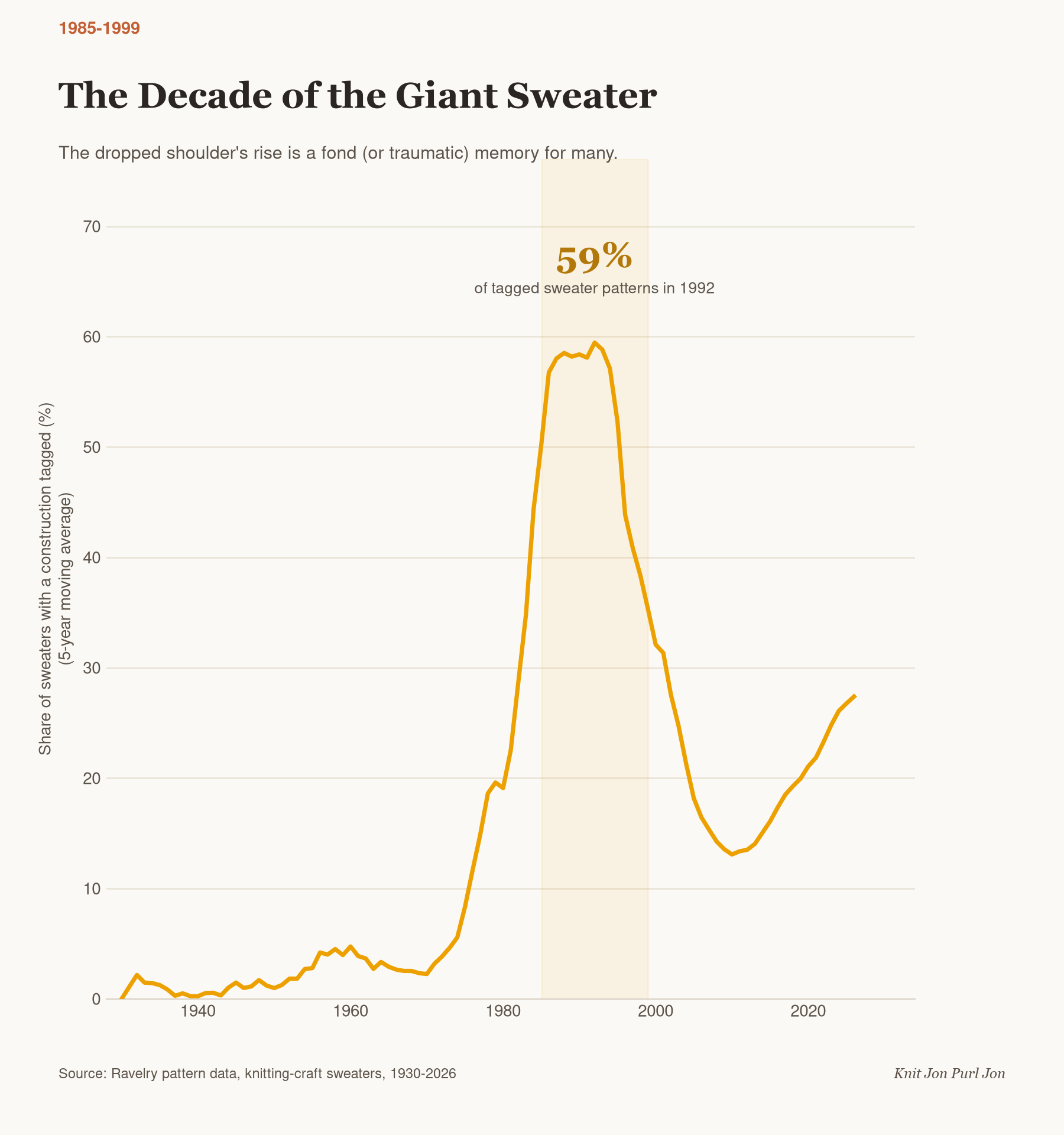
This is the fun one. If you know what an 80s or early-90s sweater looked like, you already know what a dropped shoulder does to a garment’s silhouette, and the data lines up with that memory almost exactly. Drop sleeve rises from a rounding error to well over half of tagged patterns within about a decade, stays above half among patterns dated to the 1990s, and then falls sharply once the giant-sweater look stopped being cool. It’s risen again slightly in the last few years, likely reflecting the trend for neutrally-coloured, over-sized sweaters (held with mohair, of course), that was all over Instagram a few years back.
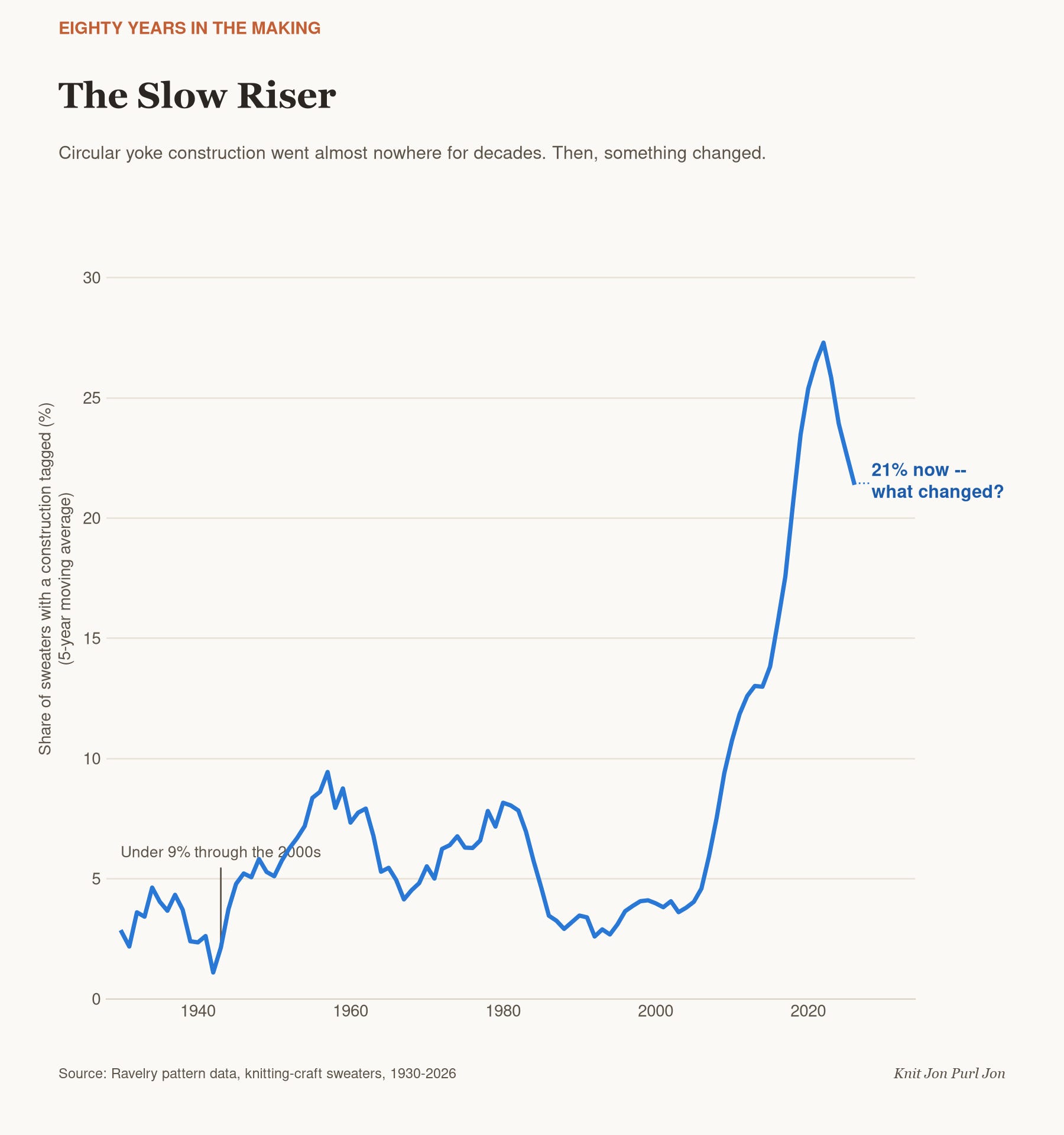
Here’s the one I was originally curious about. Circular yoke stayed under 10% of tagged patterns across eight decades and has more than doubled since, and I think the reasoning is quite unique and complex. One of the big contributors to this is the iconic Icelandic lopapeysa that is synonymous with yoke shaping, and of course, Elizabeth Zimmermann’s die-hard advocacy for seamless-knitting. But more recently, the blog and Ravelry era clearly accelerated this trend too, and I have a few thoughts on that. The history of this style and how it’s evolved will be featured soon, and these charts are just a slight detour on the way there.
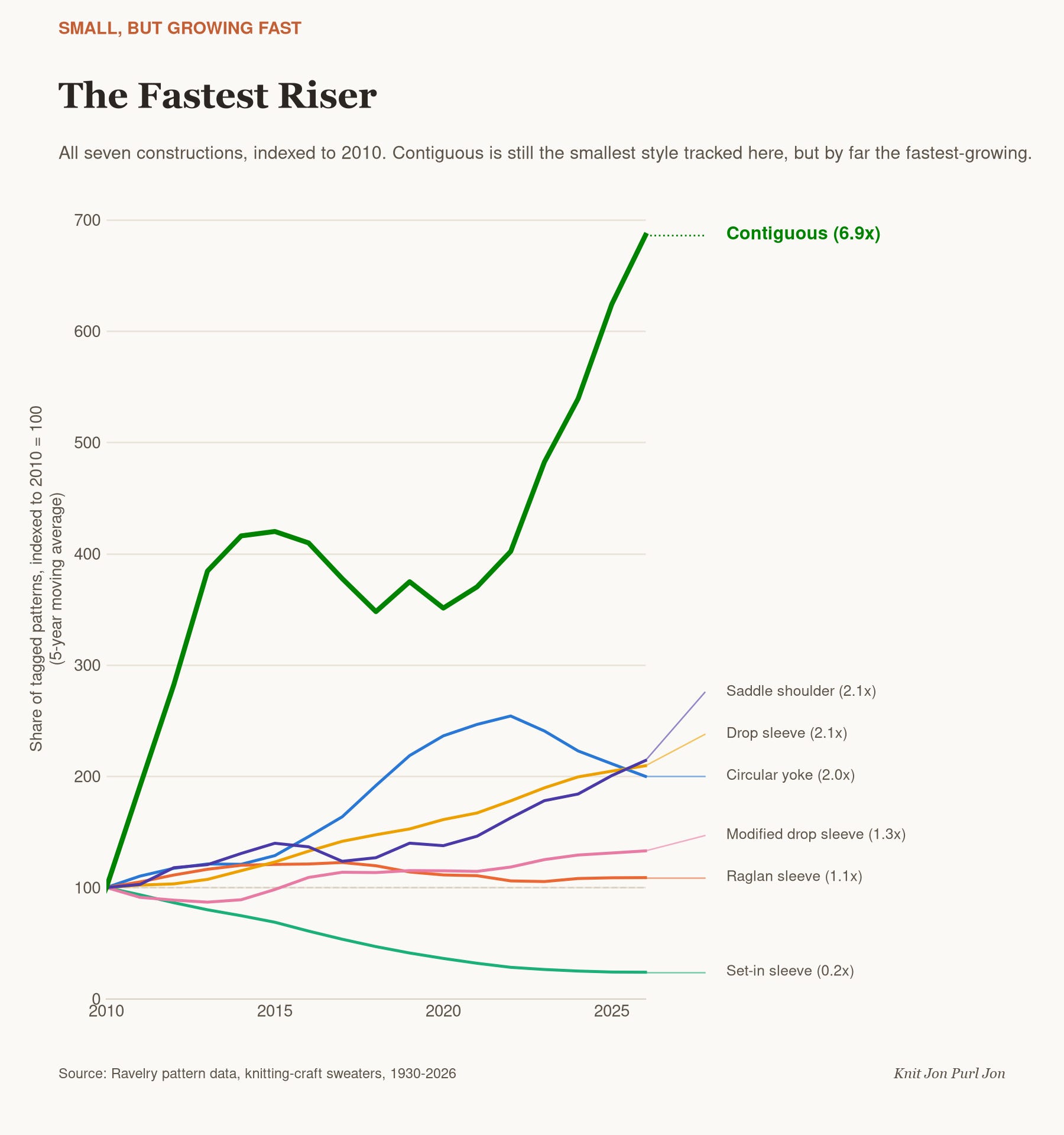
Contiguous construction originates from the same Barbara Walker and Elizabeth Zimmermann lineage as a lot of modern seamless knitting. Technically it’s a variant of set-in sleeve shaping rather than something structurally distinct, and various designers over the past 20 years or so have refined this construction and put their own spin on it. What is interesting is how fast it’s spreading: it’s grown almost seven times over since 2010, faster than any other construction, although it’s still the smallest slice on the leaderboard below. The rise of video tutorials may have something to do with it, since they make a somewhat fiddly, hard-to-describe construction much easier to tackle. It may also reflect changes in fashion, perhaps people wanting that more tailored look without resorting to the dreaded (by some) seaming.
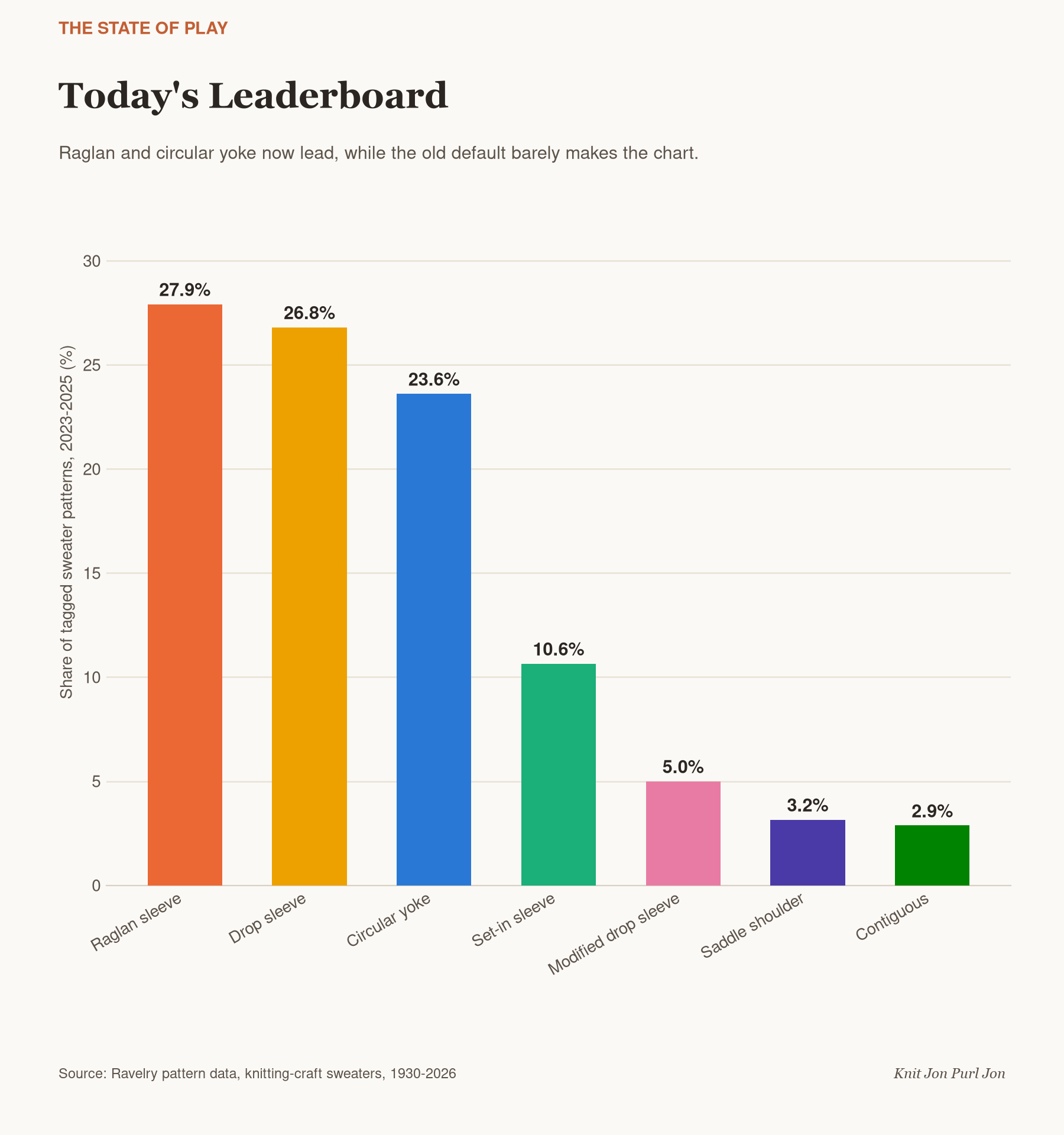
The trusty raglan is still the most common construction overall, and I know it’s a lot of people’s go-to style. The circular yoke is a close second, while the drop sleeve sits comfortably in third, likely related to the recent uptick. Set-in sleeve looks like it may be struggling, but since contiguous construction is technically one of its variants, its rapid growth might end up boosting set-in sleeve’s fortunes after all.
So there it is: seven constructions, 96 years, and quite a bit more movement than I expected going in. Did any of this surprise you? I’d love to hear if you’ve got your own memories tied to these eras, an oversized 80s jumper, a first raglan, whatever comes to mind. I’m working on a deep dive into circular yoke construction next, so if you’re curious about the history of knitting and its techniques, that’s coming soon.
Methodology note: this data wasn’t cleaned to account for patterns tagged with more than one construction. That’s probably most relevant for saddle shoulder and contiguous, since both are sometimes tagged alongside a “parent” construction rather than in place of it.
This is utterly fascinating - as someone who was a teen knitting batwing sweaters in the 80s (in electric blue mohair, no less) I can relate to so much of this. The big sweaters of the 80s were something else.
Unfortunately, there are a lot of bad raglan designs out there. With women, there are two shapes, broad shoulders and narrow shoulders. When the raglan is designed for broad shoulders, and worn by someone with narrow shoulders, you get a big gaping neck. Saddle shoulders work best for that body type. Knitters Guide to Sweater Design and Ida Riley Duncan's Knit to Fit have ways to calculate the correct raglan slope. Ankestrick has some nice designs but they just don't fit right on me. I won't mention the designer that gave me the unwearable one.
Churchmouse is one company that still designs sweaters as pieces. It's easier to work this way, as you aren't dealing with the weight and bulk of the full sweater. But people hate to sew them up. (Churchmouse also tends to drop shoulder designs. The patterns are well written and tested. I've never had a problem with one). Cabled sweaters seem to be designed o be knit flat. I wonder if that's why you see fewer patterns for them.
People on Rav definitely have pack mentality, which is why you'll see some pattern with thousands of projects. It's interesting that we finally had knitting abbreviations standardized, and then Rav designers decided to make up their own. Maybe we'll sort it back out again.