


The circular yoke sweater, with a wide band of multicoloured pattern around the shoulders and a plain body and sleeves below, is one of the most recognisable sweater shapes today, best known from the Icelandic lopapeysa. It was most likely first designed by the Norwegian Annichen Sibbern, who launched her “Eskimo”1 sweater in 1930, at the age of 25. Sibbern took the shape from a beaded collar worn with West Greenlandic national dress, which she had seen in a film released that year, and by December the design was on sale both as a hand-knitting pattern and as a factory-made sweater. The following year, Norway occupied part of East Greenland, and I find it hard to look at the launch of the sweater without that geopolitical context.
The directions in the original pattern would be familiar to many knitters today, and the style has since become a standard part of the knitting canon, as well as being taken up into traditions across Europe, from Sweden and Iceland to Shetland.
The film and the beaded collar
Sibbern was open about where the idea came from. She had seen the film Eskimo earlier in 1930, and in her own words she “seized the idea” and composed a sweater on the same motif, “a knitted shoulder piece like a wide collar, but otherwise quite plain.” The film was a Danish-Norwegian production with Norwegian dialogue, one of the first sound films made in Norway, and in it the Swedish actress Mona Mårtenson plays Evaluk, a Greenlandic woman, in West Greenlandic national dress, the kalaallisuut.
The collar Sibbern was referring to is the nuilarmiut, which is made entirely of glass beads and worn over the shoulders as part of the women’s national dress. Up to 65,000 beads can be used in a full nuilarmiut, and making one can take up to two years. Glass trade beads were brought to Greenland from the 1600s, first by Dutch whalers and later by Danish and Hanseatic traders. The large collar appeared around 1900, and it was made steadily larger until about 1910 to 1920. When Sibbern saw it on screen, it was therefore a fairly recent part of the dress. The collar was later taken up as a political symbol by the Greenlandic home rule movement.
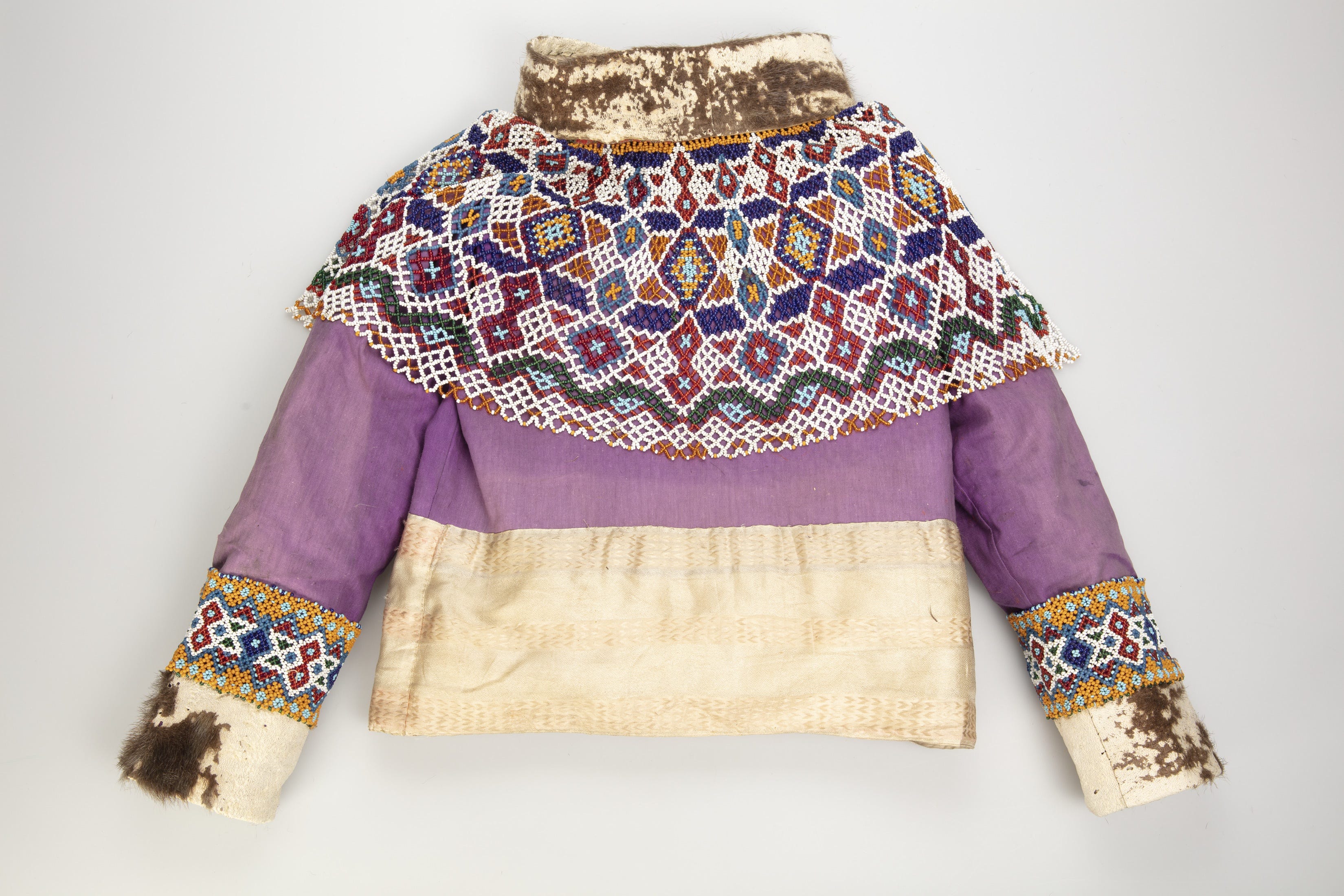
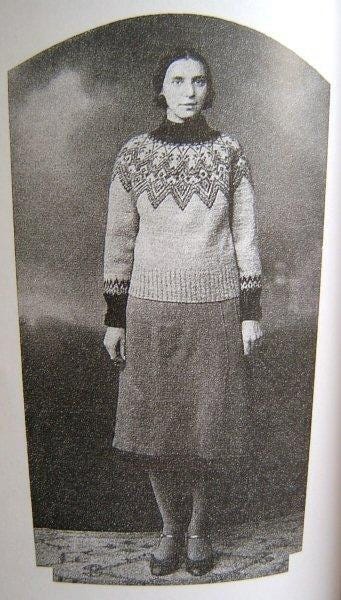
Sibbern used the shape of the collar but not its colours. The sweater in the original photograph was knitted in light brown, natural white and brown-black, without the bright reds, blues and yellows of the beadwork, possibly because the film was in black and white. In the 1931 pattern, however, “en frisk farve,” a fresh or bright colour, is specified for one of the yarns, so a knitter following the book could have made a brighter version, and the design was also sold as a loose pattern called the “Grønlænderkofte” (roughly “Greenlander sweater”), in white with red and blue.
The launch and the Greenland question
The sweater was launched in several forms within a few weeks. It was first shown in a photograph in the Norwegian magazine Urd, and the hand-knitting pattern was sold as a separate booklet. A machine-knitted version made by P. Christensen trikotasjefabrikk in Drammen was announced in the newspaper Tidens Tegn on 28 November 1930, with a large photograph of Sibbern wearing it, and the hand- and machine-knitted versions were exhibited together at two exhibitions in Oslo that December. Sibbern also offered to take orders for the sweater. The art historian Astrid Oxaal, who came across the Urd photograph by chance and whose 2003 article is the fullest account of the sweater, suggests this was a way of putting home knitters in touch with buyers at a time of high unemployment. Selling one design as a hand-knitting pattern, a factory-made sweater and a made-to-order piece in the same season seems to me a very modern way of launching it.
Oxaal argues that the sweater became known so quickly partly because it was connected to two topics in Norwegian culture and politics at the time. The first was the campaign of Foreningen Brukskunst, an association promoting more beautiful everyday objects, and the sweater was shown at the association’s opening exhibition on 8 December 1930. The second was the dispute between Norway and Denmark over Greenland. The status of Greenland had been debated in Norway since 1916, and Norway claimed the uncolonised parts of East Greenland as a Norwegian fishing and hunting ground. In 1931, Norway occupied part of East Greenland, and more of the south-east in 1932, until in 1933 the Permanent Court of International Justice in The Hague ruled in favour of Denmark.
Oxaal places Sibbern’s enthusiasm for the design, and even the choice of subject for the film, in the context of this debate and of the wider Norwegian interest in polar research. She ends her discussion by suggesting that, given Norway’s Arctic policy, the “Eskimo” sweater “may perhaps be called an unjustly appropriated Norwegian trophy from a lost exotic Arctic culture.”

What came after
After the Hague ruling went against Norway, the sweater seems to have been largely forgotten there for some years, and the next well-known round yoke in Scandinavia was Swedish. “Blå skimmer” (Blue Shimmer) was designed by Anna-Lisa Mannheimer Lunn in 1947 for Bohus Stickning, a knitting cooperative in western Sweden known for its fine colourwork sweaters, and it became the most popular of all Bohus designs. It is a round yoke cardigan, knitted in the round and cut open at the front, so its construction is similar to Sibbern’s. Bohus Stickning never connected it to the Norwegian sweater, however, and described the yoke as a jewellery-like pattern, and Oxaal points out that its motifs are closer to traditional woven patterns than to the pointed shapes of Sibbern’s design. In her reading, the two are similar only in construction, and the patterning of Blå skimmer is a new and independent design.
In Norway, the round yoke was revived in the early 1950s, again with Greenland as the inspiration. Unn Søiland Dale, who also designed the Marius sweater, now one of the best-known Norwegian sweaters, had earlier sold a similar design with raglan shaping to an English yarn company while working as a model in London. She then began a series of “Eskimo” sweaters with round yokes, and the inspiration is said to have been a 1952 photograph of the Danish royal family in Greenlandic dress, in which she mistook the beaded collars for knitting. In Norwegian, Eskimo-mønster (“Eskimo pattern”) is also used more broadly for any round-yoke pattern with a wide collar across the shoulders and chest and a plain body and sleeves.
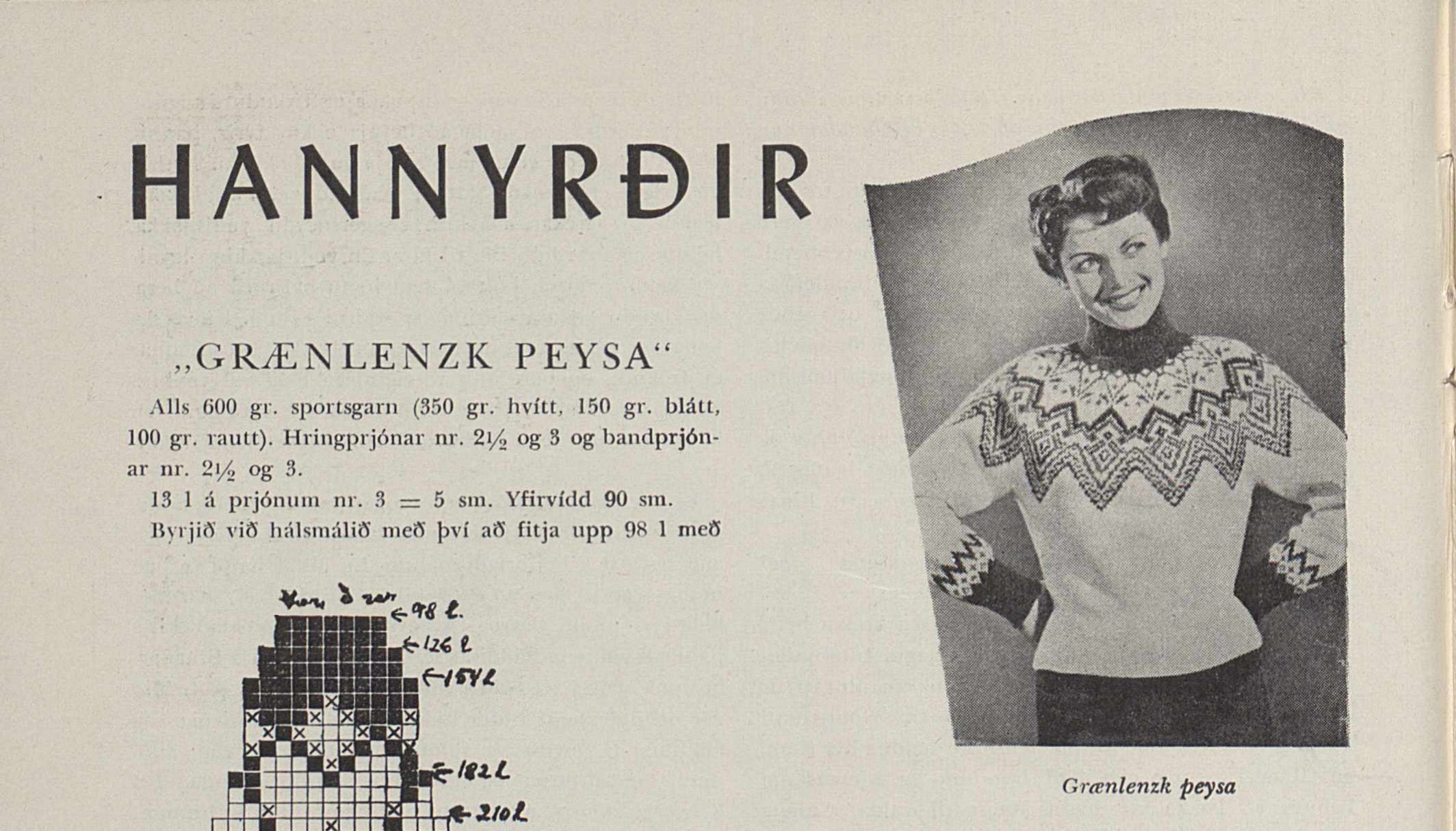
Within a few years, round-yoke patterns were also being published in Iceland. A Swedish magazine published a red, white and blue islandströje (Icelandic sweater) in 1956, and the Icelandic magazine Húsfreyjan published the design in March 1957 under the heading “the Swedes call this type of sweater the Icelandic sweater.” At the end of 1956, the Icelandic magazine Melkorka had also published a red, white and blue round yoke, knitted from the neck down, as a Grænlenzk peysa (Greenlandic sweater), so within a few months the same kind of sweater was called Greenlandic in Iceland and Icelandic in Sweden. Knitted in lopi, the lightly spun Icelandic wool, it became the lopapeysa, which after Icelandic independence in 1944 came to be treated as a national tradition.
In Shetland, where knitters were known for Fair Isle, a colourwork style worked in small repeating bands all over the garment, yoke sweaters were taken up from the 1960s. Many were knitted on domestic knitting machines up to the patterned section, and the yoke was then knitted by hand, so that hand knitters could compete with fully machine-made sweaters. In these yokes, small Fair Isle bands, known in Shetland as peerie patterns, were combined with Scandinavian stars.
Sibbern’s own pattern was not published in English until 1965. Her first book, Norske strikkemønstre (1929), a collection of traditional Norwegian knitting patterns, had been translated as Norwegian Knitting Designs in 1952, and the “Eskimo” was added to the 1965 reprint, presented as a Norwegian classic alongside the Setesdal sweater (the lusekofte, black and white with small scattered dots). In this version, the motif is slightly simplified and the colours are black and white, as in the other traditional patterns in the book.
How the 1931 pattern is knitted
This last section is for knitters, and looks at how the 1931 pattern is put together. By the definition used in the previous post, Sibbern’s sweater is a true circular yoke: the yoke is worked as one piece from the neck down to the underarm, with no raglan or set-in armhole shaping, and is then divided into the body and the two sleeves. The collar and the top of the yoke are knitted on four double-pointed needles, and once there are enough stitches to go round it, the work is moved to a circular needle, which Sibbern recommended as a practical simplification. Circular needles were still somewhat of a novelty at the time, and they were rigid, so they could not be used for a small circumference. With today’s flexible cables, the choice of needles for the neck is a matter of preference.

The pattern was included in Sibbern’s second book, Strikkeopskrifter (1931), which was printed three times up to 1939, and that is the version described here. It is written for three-ply handspun yarn in three colours, knitted on 2.5 mm needles. The choice of handspun surprised me after the English-language patterns of the same years, several of which were written to sell a particular brand of yarn. The yoke is widened with wedge shaping, with the increases drawn into the colourwork chart, so that each of the 15 motifs is widened along with the yoke. At the underarm, the front is given 25 more stitches than the back, probably to allow for the bust, and the body and both sleeves are continued in the round down to the hem and cuffs.
None of the patterns I looked at for the previous post were made this way. The nearest, “A Symphony in Green” (1935), has a yoke of the same kind, but its front and back are knitted flat from the bottom up, with armholes shaped for a set-in sleeve, and the pieces are only joined for the yoke.
Sibbern’s method of working the whole sweater in one piece in the round is still used for many circular yokes today, whether from the top down or the bottom up. In the next post, I will look at how the circular yoke was taken up in the English-speaking world from the 1960s, and at how much deeper yokes have become since.
Further reading
Most of the history in this post comes from Astrid Oxaal’s 2003 article, which is in Norwegian. The other sources are listed with what I took from each.
Hreinsdóttir, H. (2010, December 26). Hin eina sanna Eskimó peysa; Í tilefni 80 ára afmælis [The one true Eskimo sweater: On its 80th anniversary]. Blogg Hörpu Hreinsdóttur.
An Icelandic translation and redrawn chart of the 1931 pattern, the separate 1930 booklet, and scans of the Icelandic magazine pages from the 1950s.
Bertram, L. (2015, September 9). Power patterns: Discussing the Icelandic sweater and the Greenlandic nuilarmiut at the Pitt Rivers Museum. Object Lives.
The nuilarmiut and the national dress: the bead count, how long the dress takes to make, and its role as a symbol of the Greenlandic home rule movement.
Klepp, I. G. (2021). Eskimo-mønster. In Store norske leksikon.
Sibbern’s own words about seizing the idea from the film, and the wider Norwegian use of Eskimo-mønster for round-yoke patterns.
Lambert, G. A. (2002). The taxonomy of sweater structures and their origins [Master’s thesis, North Carolina State University].
How the Bohus and Shetland yokes are constructed, and how Shetland yoke sweaters were made with machine-knitted bodies and hand-knitted yokes.
Oxaal, A. (2003). Et norsk strikkemønster fra Grønland [A Norwegian knitting pattern from Greenland]. Kunst og kultur, 86(3), 158–171.
The main source: the Urd photograph, the film and the beaded collar, the launch, the Greenland dispute, and the later round yokes in Sweden, Norway and Iceland.
Sibbern, A. (1931). Strikkeopskrifter [Knitting patterns]. Grøndahl & Søn.
The pattern itself, which the section on how it is knitted is based on.
Sibbern called the sweater “Eskimo”, and I use the word in this post only as the historical name of her pattern (in quotation marks) and of the film it was named after. It is now considered offensive by many Inuit; Greenlanders call themselves Kalaallit.
This is a fascinating survey. I had no idea that the yoke sweater was related to territorial claims! I wonder whether the association of the pattern with Iceland in Sweden and Greenland in Iceland is related to a marketing gimmick... Like it's easier to market a pattern as novel and interesting if you label it as being from a foreign place.
I don't knit sweaters, but I am a huge fan of wearing yoke sweaters. So it's fun to learn all about them.
I do have a lopapeysa waiting to finish. Worked bottom to top so sleeves are ready to join to the body. Haven't decided on the yoke pattern. I used Knitting in the Old Way to make the pattern. There is a good tutorial on You Tube for these too,