


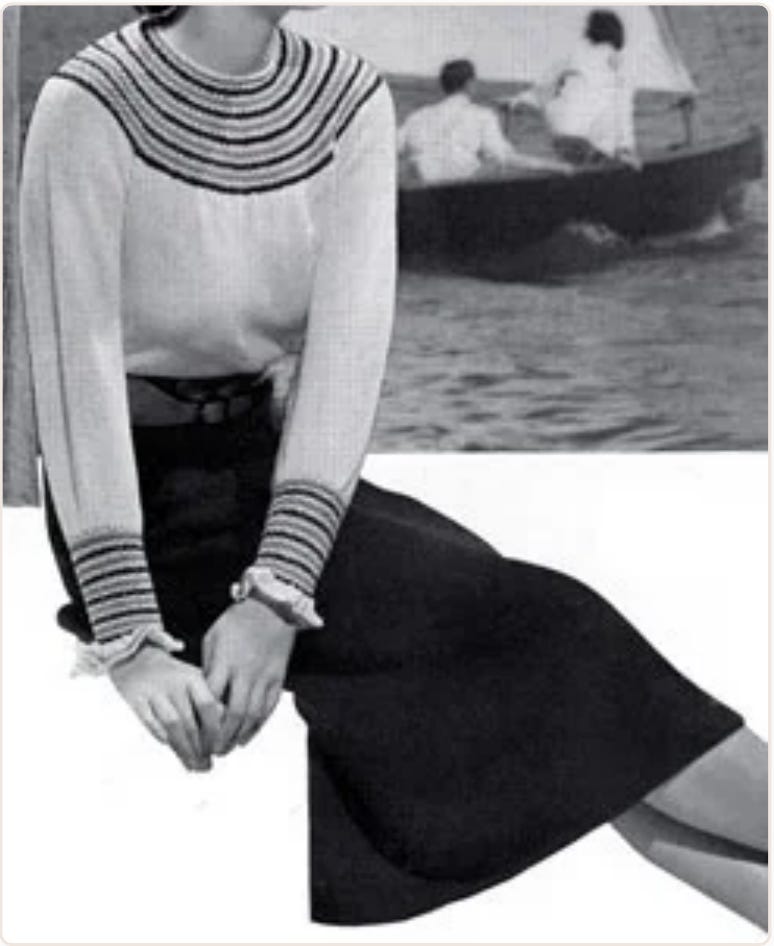
In the 1930s, knitting columns in Australian newspapers, along with a few yarn companies in Britain and the United States, printed jumpers with round yokes. Some of these yokes were crocheted and some knitted, some were made first and others added once the garment was finished, but almost all of them were added to a conventional set-in-sleeve jumper. As I clicked on some of the earliest English-language patterns tagged “circular yoke” on Ravelry, I saw none were constructed as a circular yoke sweater would be today, although two came close.
This is the first post in a short series on the circular yoke sweater. The form recognised today was most likely first designed by the Norwegian Annichen Sibbern Bøhn, whose Eskimo sweater was launched in 1930, and her design is the subject of the next post. The focus here is on what was being published in English at the same time.
What counts as a circular yoke
In a circular yoke sweater, the body and both sleeves meet at the underarm, and everything above that point is worked as one piece, shaped by increases or decreases spread evenly around it. There is no raglan line and no set-in armhole underneath. The direction of working and colourwork are not part of the definition; the defining feature is that the yoke covers the shoulder with circular shaping. Sibbern’s Eskimo already fits: in the pattern as printed in her 1931 book Strikkeopskrifter, the yoke is cast on at the collar, worked in the round on a circular needle, and divided into body and sleeves at the underarm.
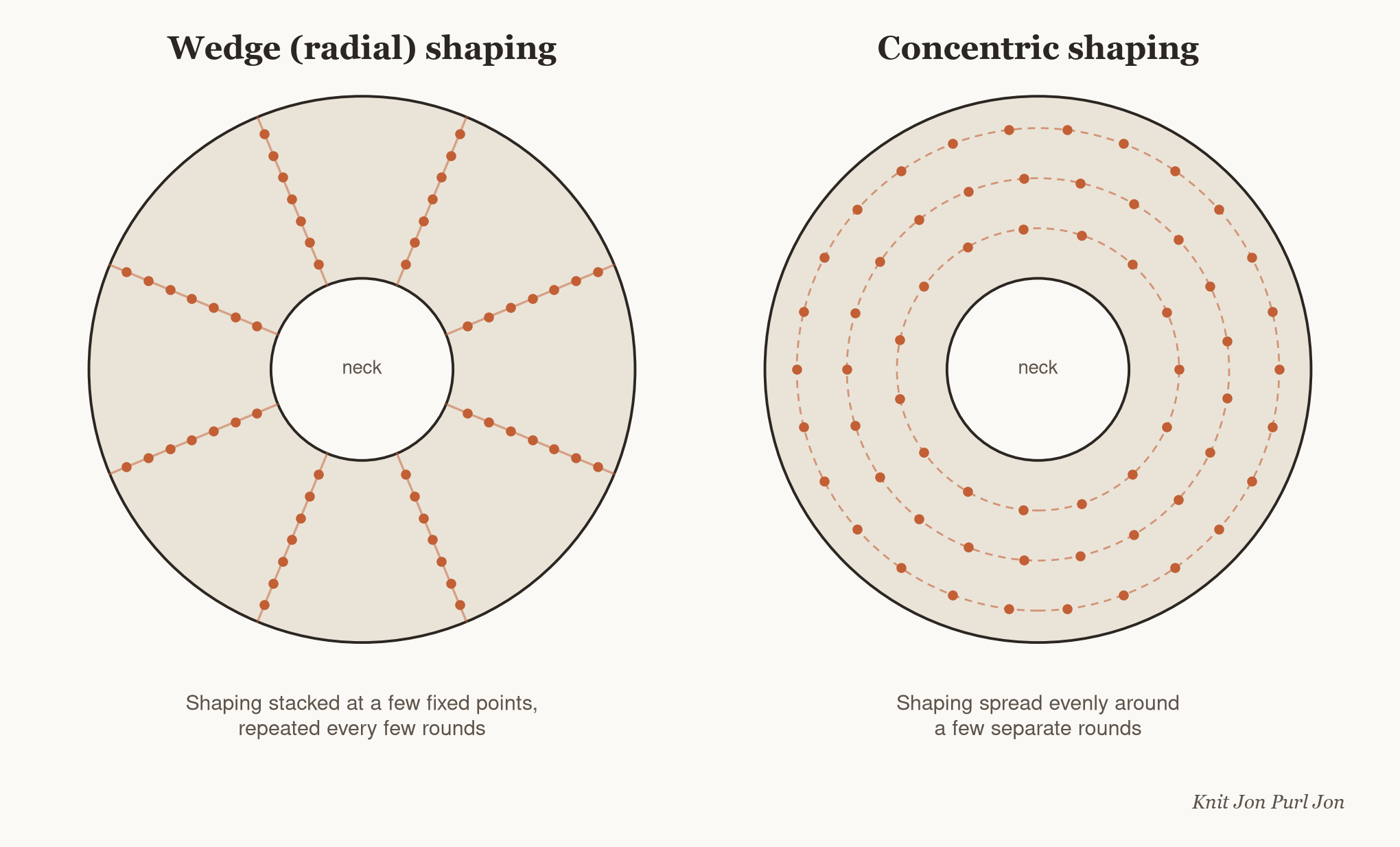
The shaping can be arranged in two ways. In wedge shaping, the increases or decreases are stacked at a few fixed points and repeated every few rounds, dividing the yoke into segments. In concentric shaping, they are spread evenly around the whole yoke on a small number of separate rounds, so that the yoke is narrowed in steps.
The patterns below are some of the earliest English-language ones tagged circular yoke on Ravelry. I was surprised to find almost nothing among them that I would recognise as a circular yoke sweater myself, so I read each one against its original printed instructions to see why it had been tagged that way.
A close contender with wedge shaping
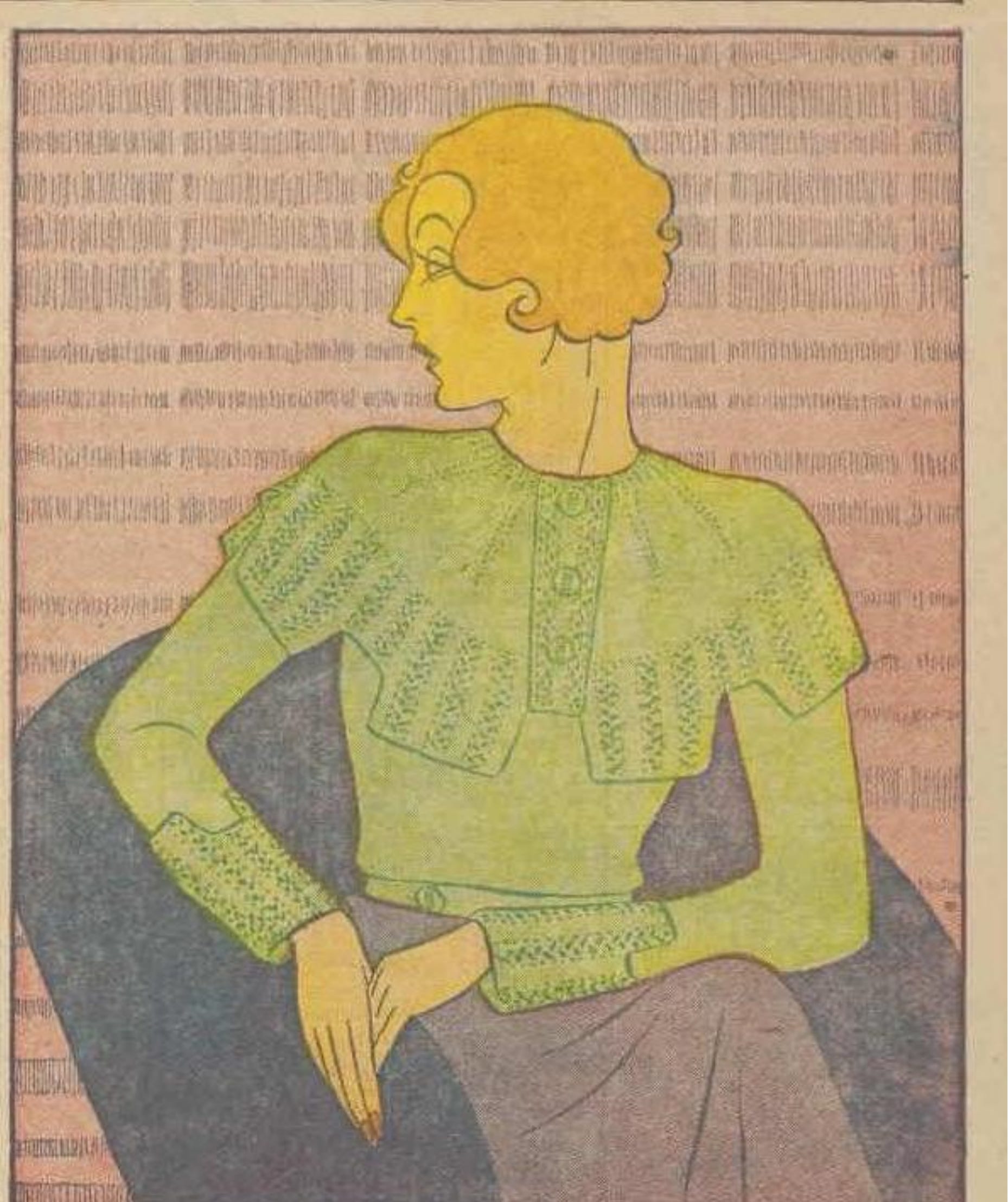
“A Symphony in Green,” from the Australian Women’s Weekly of 23 March 1935, has a back and front knitted flat from the bottom up, with armholes bound off as they would be for a set-in sleeve, but the sleeves have no cap. Ten stitches are cast off at each side for the underarm and the rest are held, and then all four pieces are joined:
“join the four pieces by knitting round on three needles (332 sts.).”
The yoke is then decreased with wedge shaping, at ten evenly spaced points every fifth row, up to the neck. Apart from the armhole shaping and a small buttoned opening at the front, this is close to how an Icelandic or Shetland yoke is built. In the Weekly it was sold as a new shape, with a “new extended shoulder-line” and “the fashionable ‘dropped’ shoulder yoke,” although “dropped” here probably describes the look of the yoke rather than the drop-shoulder construction the term refers to today. The yoke itself is plain green stocking stitch, with a separate lace collar sewn on over the top. I find it quite funny that one of the two nearest things to a modern yoke in the whole group ended up hidden under a frilly collar.
Crocheted yokes
In three of the earliest patterns, a knitted body is combined with a crocheted yoke, each in a different way. In the Laceweave Jumper (Australasian, Melbourne, October 1932), the yoke is crocheted first, round by round like a doily, and the front and back are then picked up from its lower edge and knitted downwards. In “A Very Swagger Garment” (Daily Telegraph, Sydney, November 1933), worked in green silk with stripes of cherry mohair and lemon angora (I wish the photograph were in colour), the yoke is crocheted flat and sewn in, leaving an opening at the front that is laced with a crochet chain. In “Jumper for Summer Wear” (Australasian, November 1934), the body is finished first and the yoke crocheted round the neck afterwards: “Join the shoulders and proceed to work round the neck.” All three have set-in sleeves. Three independent inventions within two years seem unlikely to me, and it is more plausible that the idea was passed around by knitting editors or by the yarn companies and shops supplying these columns.


Knitted yokes on finished bodies
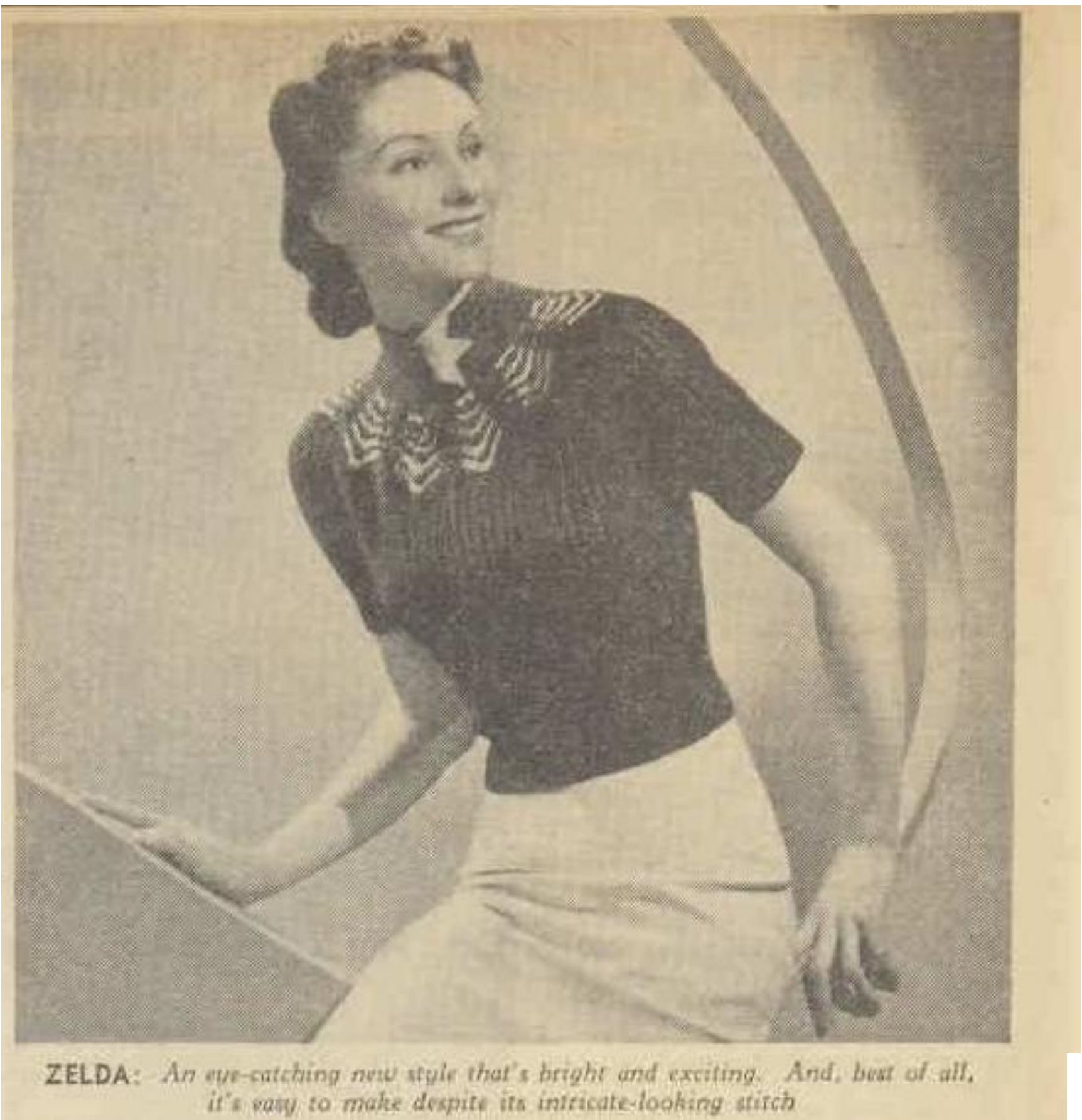
In three more patterns the yoke is knitted but still added to a set-in-sleeve body. “Jumper for the Spring” (Mail, Adelaide, 1934) has a yoke knitted sideways as a striped strip of pearl cotton and angora, “for length to fit around neck of jumper,” and then sewn in, an angora yoke a few years before Bohus made them famous. In “Persuasive Flattery,” a pattern for a jumper named Zelda (Australian Women’s Weekly, 1939), 320 stitches are picked up around the finished neckline, and the maker can choose between a crocheted yoke and one knitted in stranded colourwork “as in ‘Fairisle.’”
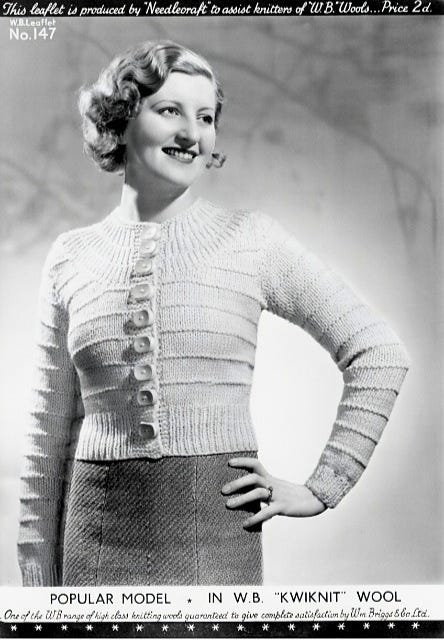
The one I find most impressive is the only British pattern here, “A Popular Model” (Wm. Briggs & Co., Manchester, 1938), which Roxanne Richardson knitted and documented in a series of videos. The body is knitted in pieces with set-in sleeves, and short rows are worked across the tops of the pieces to round out a circle at the shoulders. Once it is time to work the yoke, all the stitches are knitted across, increasing every two stitches to three. This brings the stitch count up to the full circumference of the yoke and at the same time closes up the gaps the short-row turns would otherwise leave. The yoke is then decreased towards the neck in the usual way. I think whoever worked out this way of getting a round yoke onto ordinarily shaped shoulders was a genius.
A yoke on a raglan
The other close contender, and the earliest American example in my selection, is the Hamilton Smock Stitch Blouse from the Minerva Yarns booklet Minerva Styles the Future (1936). The yoke is knitted first, in stripes of white, red and navy, and widened with concentric shaping, a stitch added in every three-stitch repeat on every fourth stripe. It is then joined and continued as a raglan down to the underarm, on a “Steel Circular Skirt Needle.” Top-down sweaters on circular needles aren’t anything new, it seems.
This combination of a round yoke with raglan shaping below it is still used today, for example in the popular Ranunculus and Anker’s Sweater patterns. Raglan shaping below the yoke gives the knitter a chance to refine the fit, and when I draft a pattern with a round yoke, I usually take this combined approach.
Taken together
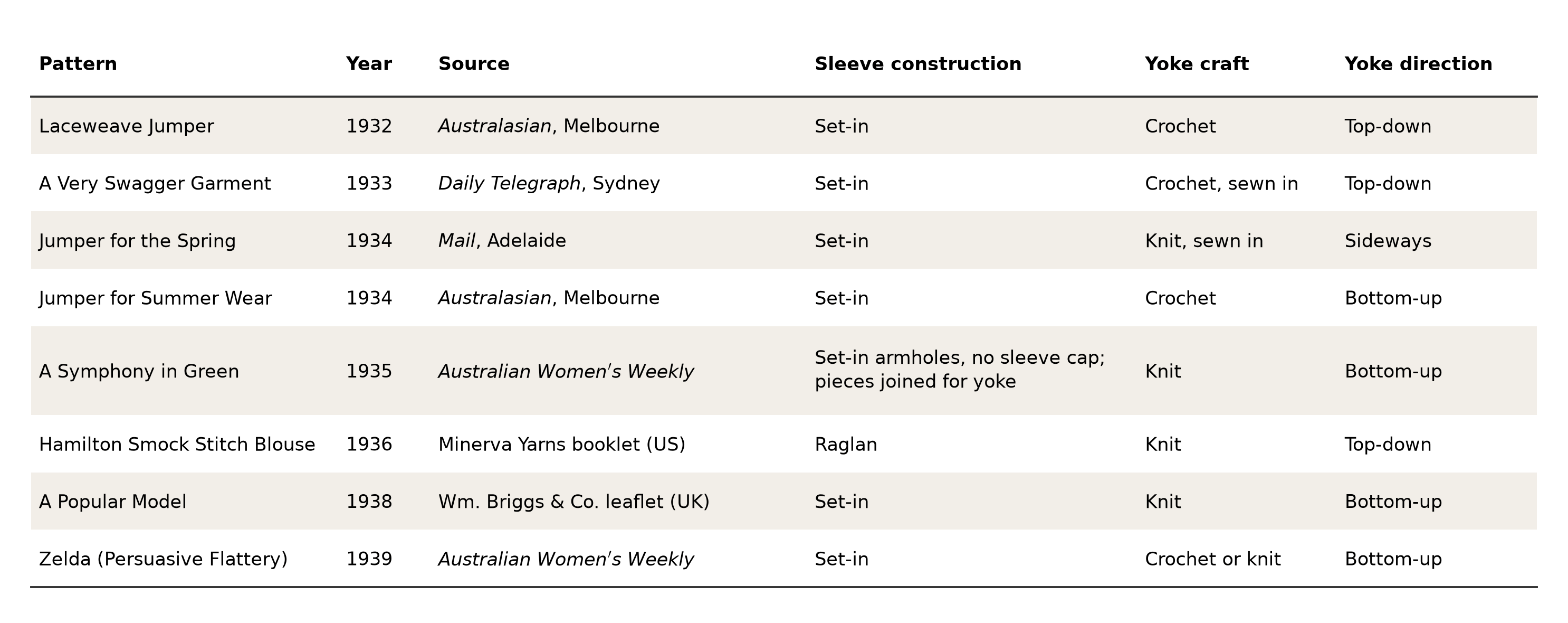
The common feature across these patterns is the body rather than the yoke. The round yoke is usually a fairly shallow band added to a set-in or raglan sweater, closer to a decorative neckline than to the deep yoke used for the whole shoulder today, which is consistent with how dominant the set-in sleeve was: among patterns dated to the 1940s, it accounts for over 90% of those with a construction tag. (If you are interested in the numbers behind this, I looked at how the popularity of each sleeve construction has changed over the last ninety years in 90 Years of Sweater Styles.) I think these garments are better understood as precursors to the circular yoke than as early versions of it. There is also no steady progress across the decade, since the two that come closest were published in 1935 and 1936, and the later patterns went back to other methods.

The number of Australian examples is probably due to the archive rather than the period. Australian newspapers are extensively digitised on Trove, and many of their knitting patterns have been added to the Ravelry database. In several of the patterns the design is also credited to Paris or “overseas,” but none of these claims can be verified, and “from Paris” may have been no more than a way to make a knitting pattern sound fashionable.
Borrowed shaping
Neither method of shaping a round yoke was new in the 1930s. The crown of a hat can be decreased in the same two ways, and so can the toe of a sock or the top of a mitten, although there are plenty of other ways to shape all three. A crocheted doily is increased outwards on the same principle, and nålbound caps and mittens were shaped in much the same way long before knitting existed. The round yoke was most likely an idea carried over from these familiar objects to a new part of the garment, and it is simple enough that a knitter could also arrive at it independently, or “unvent” it, to borrow Elizabeth Zimmermann’s term.
On a more personal note, I find myself wishing that crochet and knitting were still combined in a single garment as readily as they were in these patterns.
Meanwhile, in Norway, Sibbern’s Eskimo had been a true circular yoke since 1930. In the next post, I will look at where that design came from, including the Greenlandic beadwork it was based on and the political context of its launch, and at its later influence on Bohus in Sweden, Shetland yokes in Scotland and the lopapeysa in Iceland.
Wow, I must say I am loving this Substack! The combination of research, history, and a deep passion for knitting is really remarkable. Also, I can report that I regularly combine knitting and crochet in garments I design. I just finished a sideways short row shawl and I'm adding a crochet edging. As a lace artist, I was all over that crochet circular yoke. So cool to see artists were doing that back then.