


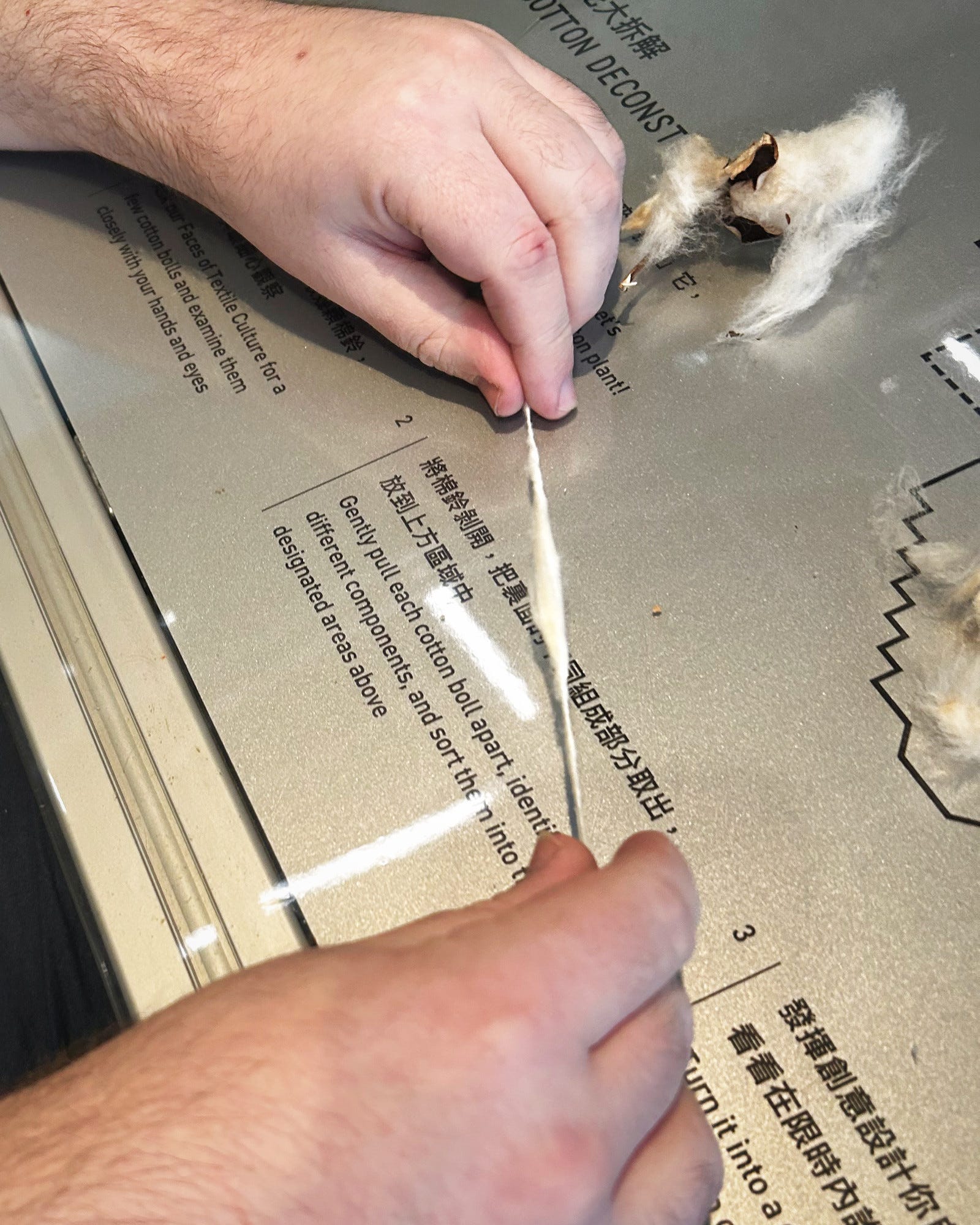
At a table in a former cotton mill in Tsuen Wan, in Hong Kong’s New Territories, there’s a plastic tub full of whole cotton bolls, with the seeds and dried husks still in them. Printed on the table are the instructions: pull a boll apart, sort it into fibres, seeds and plant material, and, if you like, race a friend to see who can take apart the most. I sorted mine, then teased a few fibres out of the fluff and twisted them between my fingers into a short length of yarn.
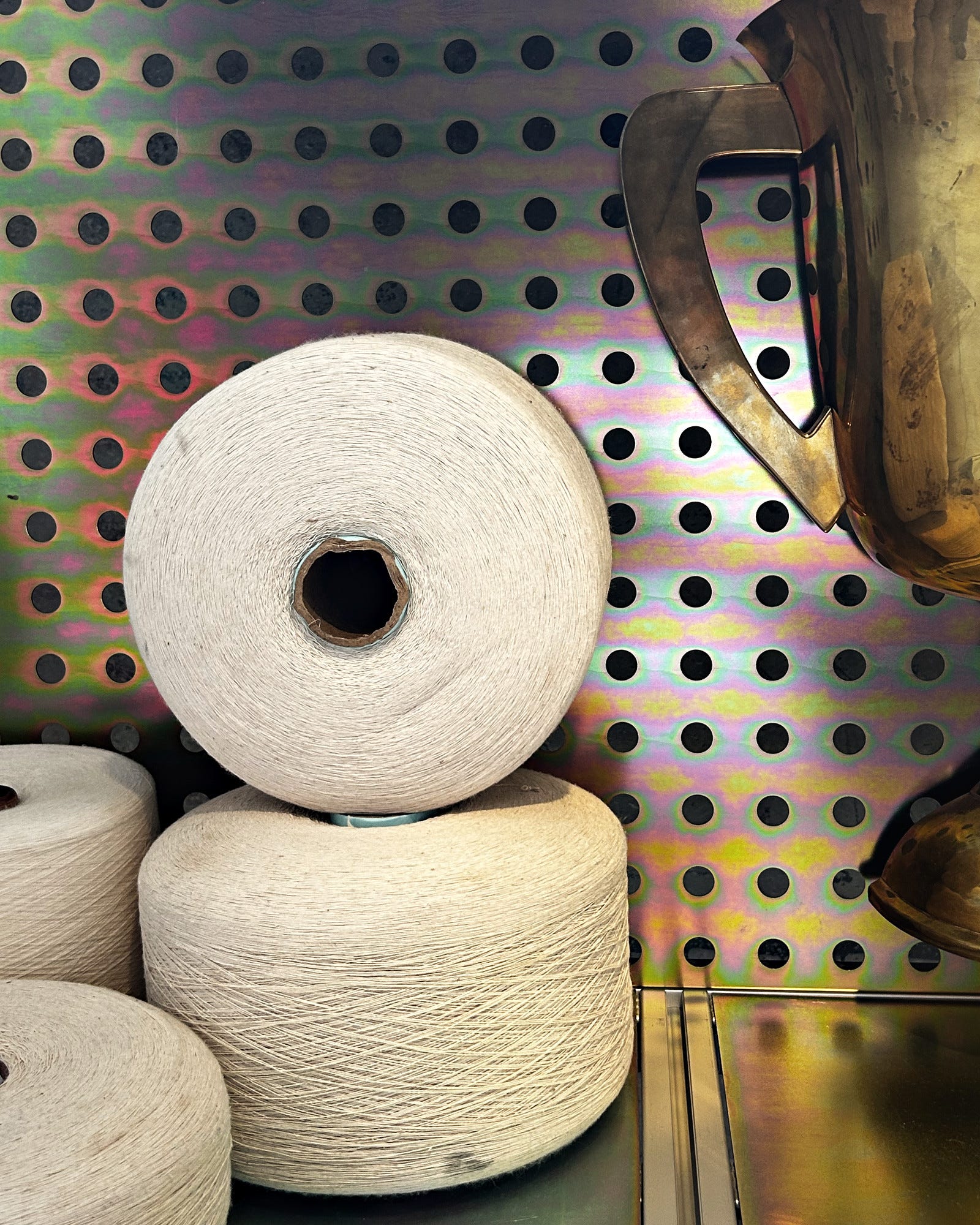
This was at CHAT, the Centre for Heritage, Arts and Textile, which officially opened in 2019 in Mill 6 of Nan Fung Textiles, for a time Hong Kong’s biggest cotton spinner. Nan Fung had 6 mills, and Mill 6 is one of the 3 still standing. A few steps from the table, cans of cotton sliver coiled in neat rings stand in front of a drawing frame that CHAT calls “Hong Kong’s only operating industrial drawing frame”. It came from Tai Hing Cotton Mill, the last cotton spinning mill in Hong Kong, which closed in 2014. It wasn’t running when I visited, but it’s usually switched on once a month for a demonstration by a former mill worker.
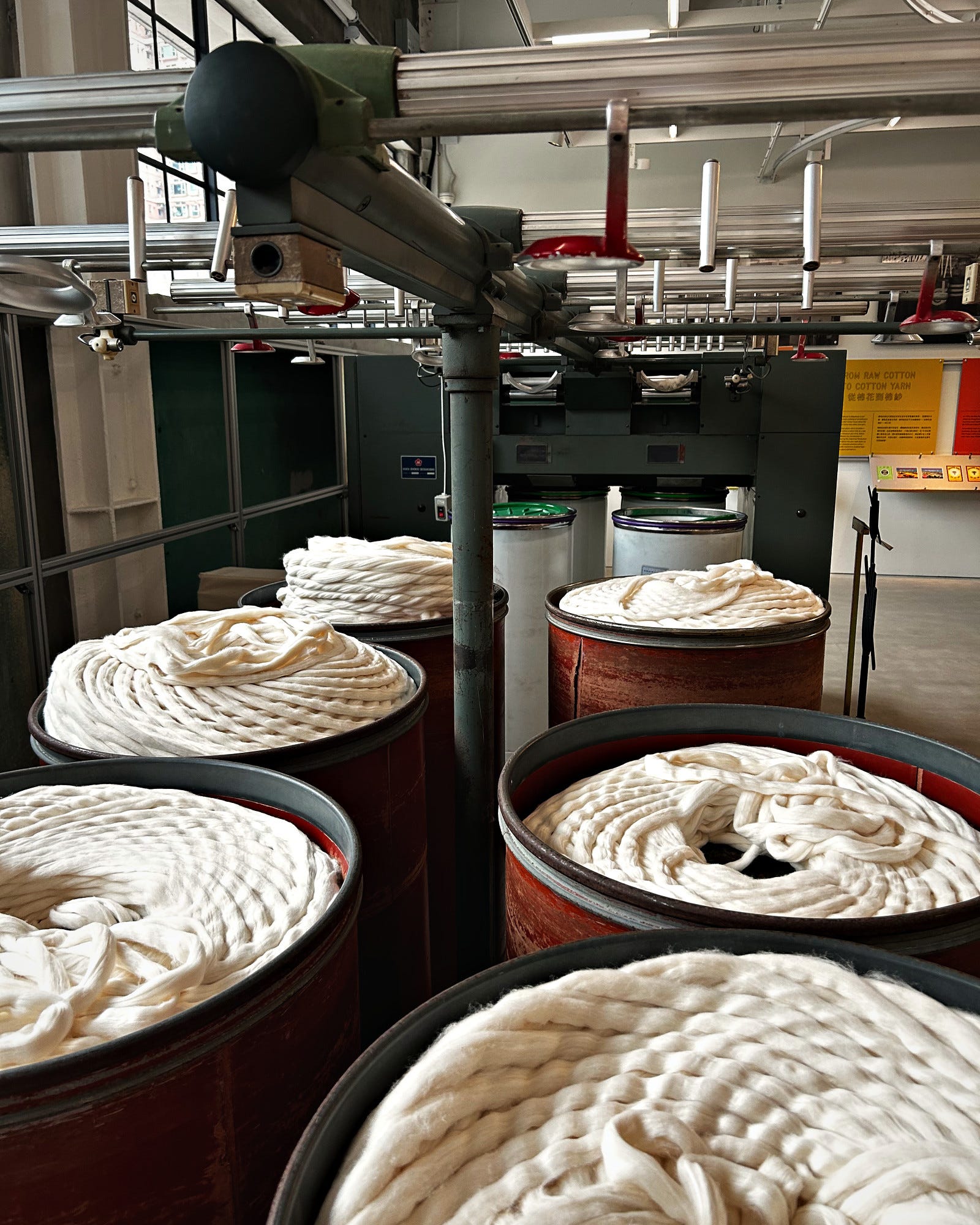
Drawing is the step between carding and roving. Several card slivers are doubled, or run together, and pulled out between pairs of rollers turning at increasing speeds, which evens out the thick and thin places and lines the fibres up. In hand spinning you even out the fibre yourself as you draft, though carding or combing it more than once does a similar job. Drawing frames like CHAT’s go back to the first British cotton mills: Richard Arkwright patented machinery for carding, drawing and roving in 1775.
Earlier this year I wrote about why knitting survived the Industrial Revolution when hand spinning didn’t, or at least not to the same extent. (Ironically, I’ve since become a spinner myself.) Once mills in Britain could spin yarn faster and more cheaply than the women and children who had spun it at home, there was no reason left to teach spinning, and within a generation or two most people had stopped. Eventually industrial spinning declined in Britain too: over the 20th century Lancashire lost most of its cotton trade to mills in Asia, in India and Japan as well as Hong Kong. Hong Kong’s mills later closed too.
Twisting the cotton by hand was a bit strange, because it was so close to the earliest kind of spinning, with no tools at all, not even a spindle. My partner, who doesn’t spin, enjoyed it too, and I think the penny finally dropped about what I’ve been spending so much of my time on for the past few months.
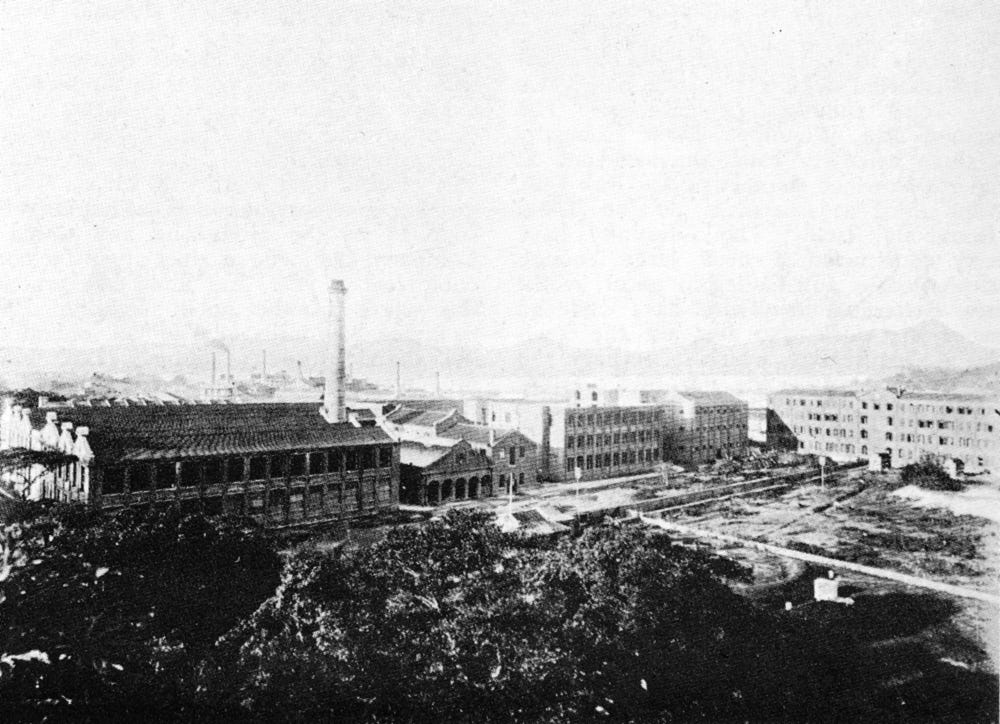
Hong Kong’s first big cotton mill was set up in 1898, when the trading firm Jardine, Matheson & Co. founded the Hongkong Cotton-Spinning, Weaving and Dyeing Company at Causeway Bay, and it started spinning in 1899. Each spindle on a spinning machine twists and winds a single strand of yarn, so the number of spindles is the usual way of measuring a mill’s size, and by 1908 this one had over 55,500. All of the machinery came from Platts of Oldham, in Lancashire, which by 1900 was the largest maker of textile machinery in the world. It didn’t last: spinning seems to have stopped around 1910 or 1911, the machinery went to Shanghai, and in 1914 the company was wound up. According to the Industrial History of Hong Kong group, the reasons were a shortage of skilled workers, too little electricity and clean water, and the humid weather, in which the yarn was difficult to spin.
Hong Kong had long had small businesses that wove cloth and dyed and finished it, but in 1945 it still had no spinning mills, so their yarn came from elsewhere. Most of China’s big cotton mills were in Shanghai and the towns around it, and others were in northern cities like Qingdao and Tianjin.
After the war, mill owners started moving in the opposite direction, from Shanghai to Hong Kong. Several Shanghai mill owners had ordered new machinery from Britain and the United States, but with civil war and hyperinflation in China it was hard to import, so they installed it in Hong Kong, intending to move it to China later, and it stayed. Soon after the war C. C. Lee came from Shanghai and brought in the first spindles, and by 1955 Hong Kong had 300,000.
The owners are usually called Shanghainese, though many came from elsewhere in the region around Shanghai, such as Wuxi or the Zhoushan islands near Ningbo. They brought chief engineers and skilled workers with them: Lee, for example, hired 60 skilled workers from Shanghai to train his staff. The new mills were built with ventilation and air-conditioning, so the humidity was less of a problem than it had been for the first mill.
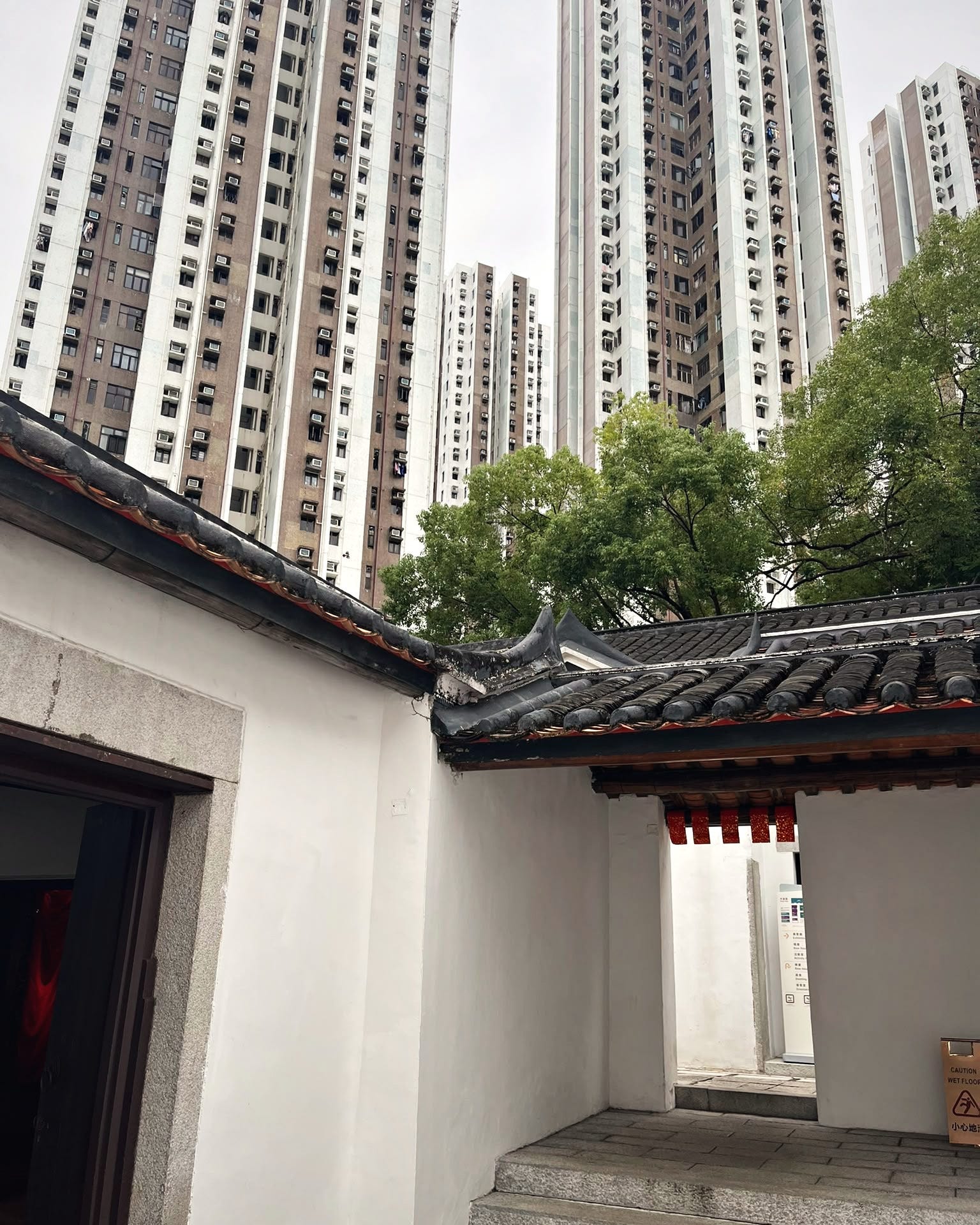
Many of the new mills were built in Tsuen Wan, where CHAT is now, north-west of Kowloon. Before the war it was a small market town surrounded by Hakka villages, where people farmed, fished and made incense sticks. With its spinning mills and dye works, it was nicknamed “Little Manchester”, and its population grew from about 5,000 before the war to about 260,000 in 1971. In 1961 the government made it a planned “satellite town”, with its own housing and industry, and it’s now counted as Hong Kong’s first new town.
One of the mill owners there was Chen Din Hwa, from Ningbo, who came to Hong Kong in 1949 and founded Nan Fung Textiles in 1954. Its first mill started spinning about 2 years later, at 400 bales of yarn a month, and by the early 1980s Nan Fung had the biggest capacity of any mill in Hong Kong. The yarn was sold under the Golden Cup brand, and Chen became known as the “King of Cotton Yarn”.
Next to Lancashire, Hong Kong’s industry was tiny. In the mid-1950s, when Lancashire started to worry about it, Hong Kong had about 200,000 spindles and Britain more than 25 million. Even at its peak, around 1970, Hong Kong had only about 900,000. Where Hong Kong had the advantage was in running hours and wages. In the mid-1950s each spindle in Hong Kong ran for about 8,000 of the 8,760 hours in a year, by the Hong Kong spinners’ own reckoning the most in the world, against about 3,000 in Britain, where shift work was much less common. In a 1969 report on the British industry, average wages in Hong Kong, India, Pakistan and Portugal were estimated at about 25% of British wages. So although Hong Kong produced far less than Lancashire, the labour in each yard of its cloth cost much less, and in the early post-war years its mill owners made high profits.
Hong Kong’s cotton cloth exports to Britain rose from 5 million square yards in 1950 to 123 million in 1960. In January 1957 a delegation from Lancashire visited Hong Kong and India to ask for limits on cloth exports, warning of the “virtual extinction” of the industry at home. In 1958 the British government sent a senior civil servant to Hong Kong to press the mill owners, and by early 1959 Hong Kong, India and Pakistan had all agreed to “voluntary” limits on the cloth they sent to Britain.
1959 was also the first year in which Britain imported more cotton and rayon cloth than it exported. Under the Cotton Industry Act of the same year, firms were paid to scrap surplus machinery (the government paid two-thirds of the cost, and a levy on the rest of the industry paid the other third), and about half of the industry’s spindles were scrapped. The historian John Singleton writes that the government’s underlying aim was “to help the industry to decline gracefully”. Between 1950 and 1970, the number of people working in the British cotton industry fell from 244,000 to 76,000.
Jack Tang’s family, spinners from Wuxi, ran another Tsuen Wan mill, South Sea Textile, which opened in 1949 with 10,000 spindles. When Tang arrived in Hong Kong in 1955, getting to the mill meant a ferry across the harbour and then the factory car from the clock tower at Tsim Sha Tsui, 20 minutes up what was still a narrow country road. The same trip now takes about half an hour on the MTR, Hong Kong’s metro, and Tsuen Wan is a town of endless tower blocks and pedestrian walkways.
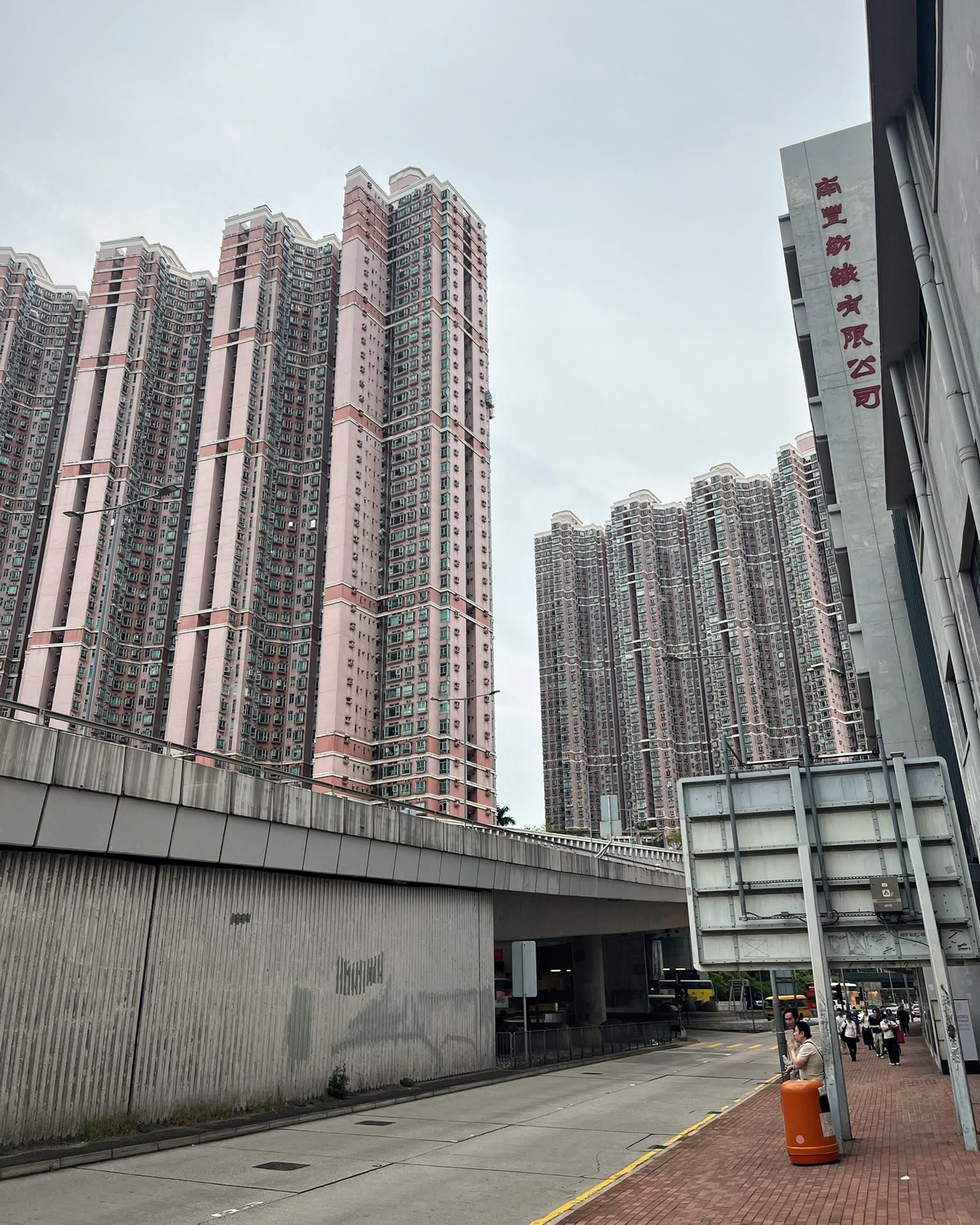
South Sea had about 1,500 workers and staff. Its site was split by the road, with a tunnel underneath: the machinery was on one side, and on the other were the men’s and women’s dormitories, a canteen and a large flower garden. In his oral history, Tang remembered hundreds of people queuing at the gate for work when the mill opened, and 6 years later, in 1955, when a notice went up at the gate, 10 or 20 people still applied for each job. A mill worker earned a little more than a live-in maid’s HK$70 a month, with a dormitory place and subsidised meals.
The first mills ran around the clock on two 12-hour shifts, and in 1947 the only rule was that women and children could not work at night. Later the working day was split into three 8-hour shifts. By 1970 about 22,000 people worked in Hong Kong’s spinning mills. Tse Chi-kin, a technician at Nan Fung in the 1970s, told a writer for Cathay Pacific in 2018 that there used to be scores of spinning machines on every floor, running day and night: “You couldn’t hear yourself think.” He worked 8 hours a day, 6 days a week, with no lunch hour, and ate while he worked.
CHAT has been collecting memories like these in its Memory Bank. In one, Chan King Keung describes how, at 19 in 1968, he was one of 6 people chosen for the first trainee programme at Oceanic Cotton Mill in Tsuen Wan, and later became a foreman. The trainees lived at the mill during the week, with lectures morning, afternoon and evening and a 10:30pm curfew. In another, Alan Chan, a cotton buyer at Nan Fung until it stopped spinning in 2008, explains that raw cotton was about 60% of a spinning mill’s costs. Cotton wasn’t grown in Hong Kong, so all of it was imported, from the United States, Brazil, Tanzania, Uzbekistan, India, Pakistan, mainland China and elsewhere. Buyers judged the length and colour of the fibre by drawing a pinch of it out against black flannel.
In the late 1960s the mills ran short of workers: by 1968 they had to advertise in the newspapers, and Tang remembered rival mills sending buses to a competitor’s gate to take its workers away. The number of spindles in Hong Kong never reached a million, because several owners moved their spinning to Malaysia, Indonesia, Africa and Taiwan, and later to mainland China. Between 1974 and 1975, spinning in Hong Kong shrank by 30%.
In the late 1970s Tang sold the unused part of South Sea’s site for housing, and later worked out that he had made far more from that land than from all the years of manufacturing since 1949. From the 1970s Chen Din Hwa built Nan Fung into one of Hong Kong’s biggest property developers, but he kept the mills spinning, though Tang thought they were probably losing money, and put this down to an old-fashioned wish to be known as an industrialist, not as a speculator or a property tycoon.
South Sea closed in 1991, and by the time Tang retired in the mid-1990s only 3 spinning mills were left in Hong Kong. Nan Fung stopped spinning in Tsuen Wan in 2008, and after that its last 3 mill buildings were used as warehouses. Tai Hing closed in 2014, nearly 70 years after the first post-war mill opened. In December 2018 Nan Fung reopened Mills 4, 5 and 6 as The Mills, with shops, a start-up centre and CHAT.
By 1979 cotton was no longer the biggest industrial employer in the county of Lancashire, which since 1974 had no longer included Oldham, Bolton or Manchester, and most of the last spinning mills in the region closed in the 1990s. Elk Mill in Oldham, the last mule-spinning mill built in Lancashire, closed in 1998, though by then it had replaced its mules with ring frames. In 2016 a company in Dukinfield, near Manchester (and historically in Cheshire), started spinning cotton again in Tower Mill, built in 1885, but it stopped after its parent company went into administration in 2024. The new owners call a return to spinning “an ambition for the future”.
At CHAT, all the spinning in Mill 6 now is done by hand, at the hand-spinning demonstrations and by visitors like me at the table. The drawing frame demonstrations are given by Leung Fung Yee, who ran spinning machines in several mills, Nan Fung among them, in the 1980s and 1990s. My own wheel, a secondhand Wee Peggy built in New Zealand, has a single flyer, and my first skein on it took 3 evenings to spin and ply. A mill like Nan Fung’s ran tens of thousands of spindles around the clock. The machines at CHAT are big, but what I remember most is the size of the buildings, and I can only imagine what they were like with every floor full of running machines.
I liked that CHAT is trying both to keep the history of the mills alive and to show how much fibre and textiles have mattered in Hong Kong, to the city as a whole and to individual people. Illumin-Loom, an installation where you design a pattern on strips of light that stand in for the threads of a fabric, was a lot of fun. Cotton is still spun in mills, of course, just not in Lancashire or Hong Kong any more, and I came away wondering whether the places it moved to will lose it in turn, and where it will go after that.
CHAT’s director, Takahashi Mizuki, told the New York Times this year that if you ask young people in Hong Kong what their parents or grandparents did, there is a good chance they will say the textile industry. I suspect the same is true of many families in Lancashire, though probably a generation or two further back. Did anyone in your family work in a mill? I’d love to hear about it in the comments.
Further reading
Carles Brasó Broggi, “The Rise of Hong Kong’s Textile Industry, 1945–1974: The Role of the Hong Kong Spinners Association (HKSA),” Business History (2025): open access; how Shanghai’s spinners built Hong Kong’s industry, with yearly figures for spindles and workers.
John Singleton, “Homage to Lancashire: The Cotton Industry, 1945–65,” PhD thesis, Lancaster University (1986): free online; Lancashire’s decline after the war, the 1959 import limits and the Cotton Industry Act.
Jack Tang, “The Textile Industry and the Development of Hong Kong, 1949–1999,” oral history by Carolyn Wakeman, Bancroft Library (2003): free online; South Sea Textile in Tsuen Wan from the 1950s to its closure in 1991.
Christopher DeWolf, “Hong Kong’s Modern Heritage, Part IV: The Mills,” Zolima City Mag (2019): Nan Fung’s mills and their conversion into The Mills and CHAT.
Grace Tsang, “The Personal Cultivation of a Cotton Buyer,” CHAT blog (2021), and Pat Cheung, “Spinning Mill Intern Handbook,” CHAT blog (2022): two of CHAT’s Memory Bank pieces, based on interviews with former mill staff.
Ed Peters, “How The Mills Is Reinventing Hong Kong’s Textile Heritage,” Cathay (2018): includes the memories of Tse Chi-kin, a technician at Nan Fung in the 1970s.
Hugh Farmer, “The Hongkong Cotton-Spinning, Weaving and Dyeing Company Ltd 1898–1914,” Industrial History of Hong Kong (2015): Hong Kong’s first big cotton mill.
They should have spun linen - flax loves humidity.
Interestingly, while the US has a hand spinning tradition, by the time Australia was settled by Europeans in 1788 hand spinning had almost completely died out. The only hand spinning of any note is from the 20th century craft tradition, starting from rehabilitation for WWI returned soldiers. While there were industrial looms from the 19th century, the oldest hand looms also were imported for soldiers suffering from shellshock.
This is super interesting, I live just up from Pear Mill, in Stockport which was running till 1978, so very contermperous to HK.