


One thing that has always fascinated me about knitting is how widespread it remains, centuries after the craft was first developed. Many people learned through their family (for me, it was my Grandma), and the knowledge has been passed down by choice through generations. In some countries, knitting is still taught in schools, but even then, many children arrive already knowing how to do it. Originally, knitting was done in the home in order to provide clothing for the family or to sell items to supplement income. Hand spinning was once just as common, done at home out of the same necessity. The two crafts did not go the same way.
Before the Industrial Revolution, almost every household spun, and spinning was a constant background activity rather than a hobby, fitted around everything else. Women and children picked up a spindle at any spare moment throughout the day, and this yarn would go on to weavers who would produce cloth. Even with the spinning wheel, which had greatly increased productivity over the spindle, it is estimated that eight spinners were still needed to supply the yarn for a single weaver’s loom.
The flying shuttle, invented in 1733, made the bottleneck in spinning worse. By allowing one weaver to do the work of two, it meant looms could run faster and demand more yarn than before. Thirty years later, the spinning jenny was invented, making it possible to spin multiple threads at once. Production began moving out of homes and into mills, amplified by water power and then steam. This was the beginning of industrialisation as it is usually pictured: factories, mechanised production, large-scale labour systems, and supply chains that reached across the world. Those supply chains were already global before the end of the eighteenth century. The rapid expansion of British textile production depended on cotton, much of it grown by enslaved people in the Americas. Mills processed that cotton into cloth, which was then exported around the world.
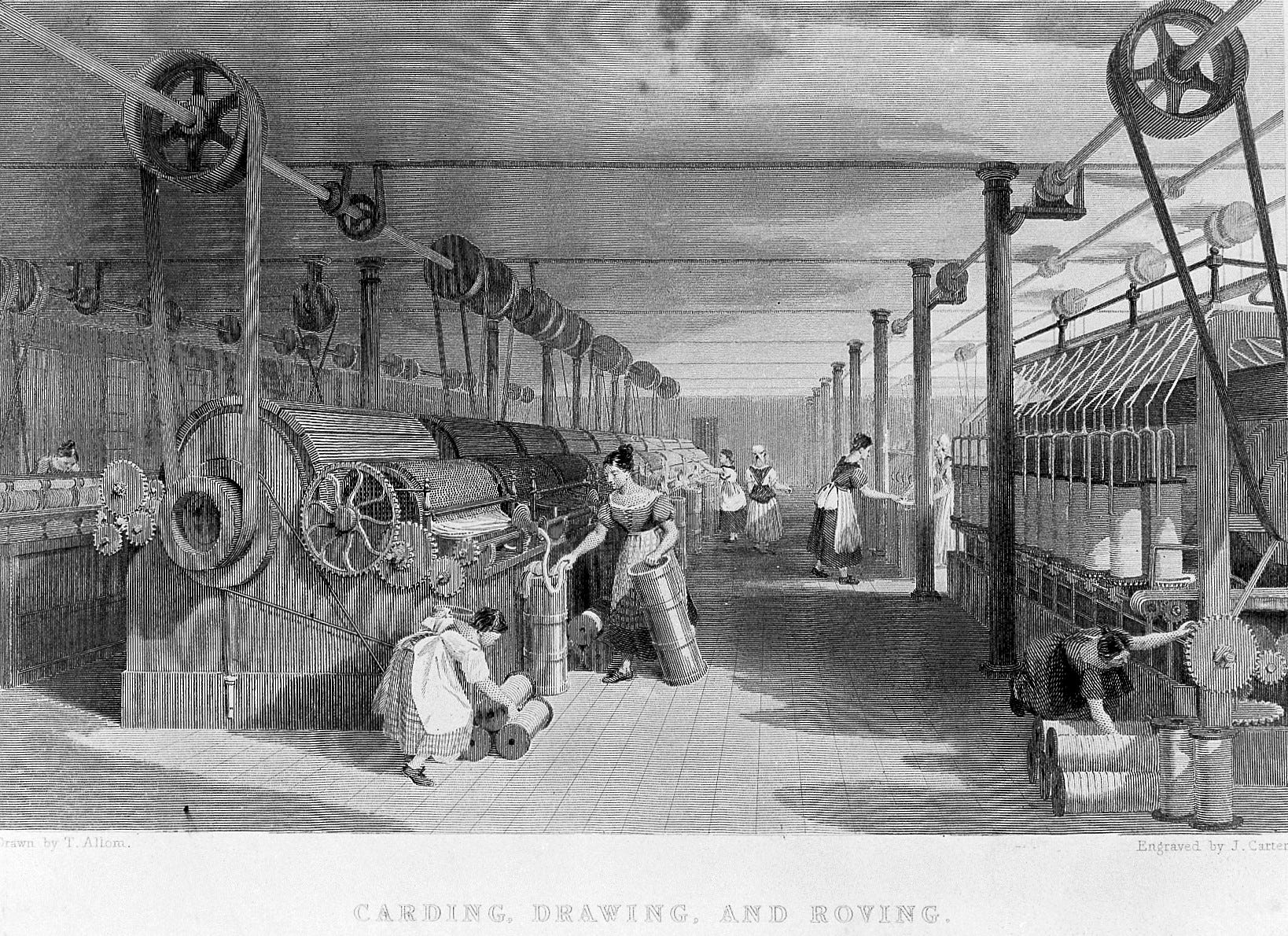
Within a generation or two, the domestic spinning that had occupied women and children for centuries had for the most part disappeared. The knowledge stopped being passed down, and weaving followed much the same path. Hand spinning and weaving exist today, but as specialist crafts, not as things most people do or learn as a matter of course, which is not true of knitting.
* * *
Part of the explanation is structural: in 1589, William Lee invented the stocking frame, a machine that reproduced the motions of hand knitting using rows of hooked needles. It could produce stockings quickly and consistently, and it eventually spread across parts of England. But instead of giving rise to factories, it gave rise to the framework knitting industry: machines operated in homes and small workshops, with workers producing goods for merchants, often using frames that they rented rather than owned. Knitting was mechanised, but the work was not reorganised into factories, which is what usually defines industrialisation.
There was less economic pressure on knitting than on spinning, too. Mechanisation was usually applied first to the slowest stage of production, and spinning was by a wide margin the slowest stage in textiles. Until that problem was solved, there was limited incentive to mechanise anything else. Woven cloth was also far more central to early modern economies than knitted goods, since it was used for uniforms, sails, trade goods, and household fabrics, all of which were produced and traded on an enormous scale. Knitted goods (stockings, caps, gloves) wwere vital to daily life but not to the large-scale economic systems in which investment and mechanisation were concentrated. Investment went to spinning and weaving, and knitting was largely left to develop on its own terms.
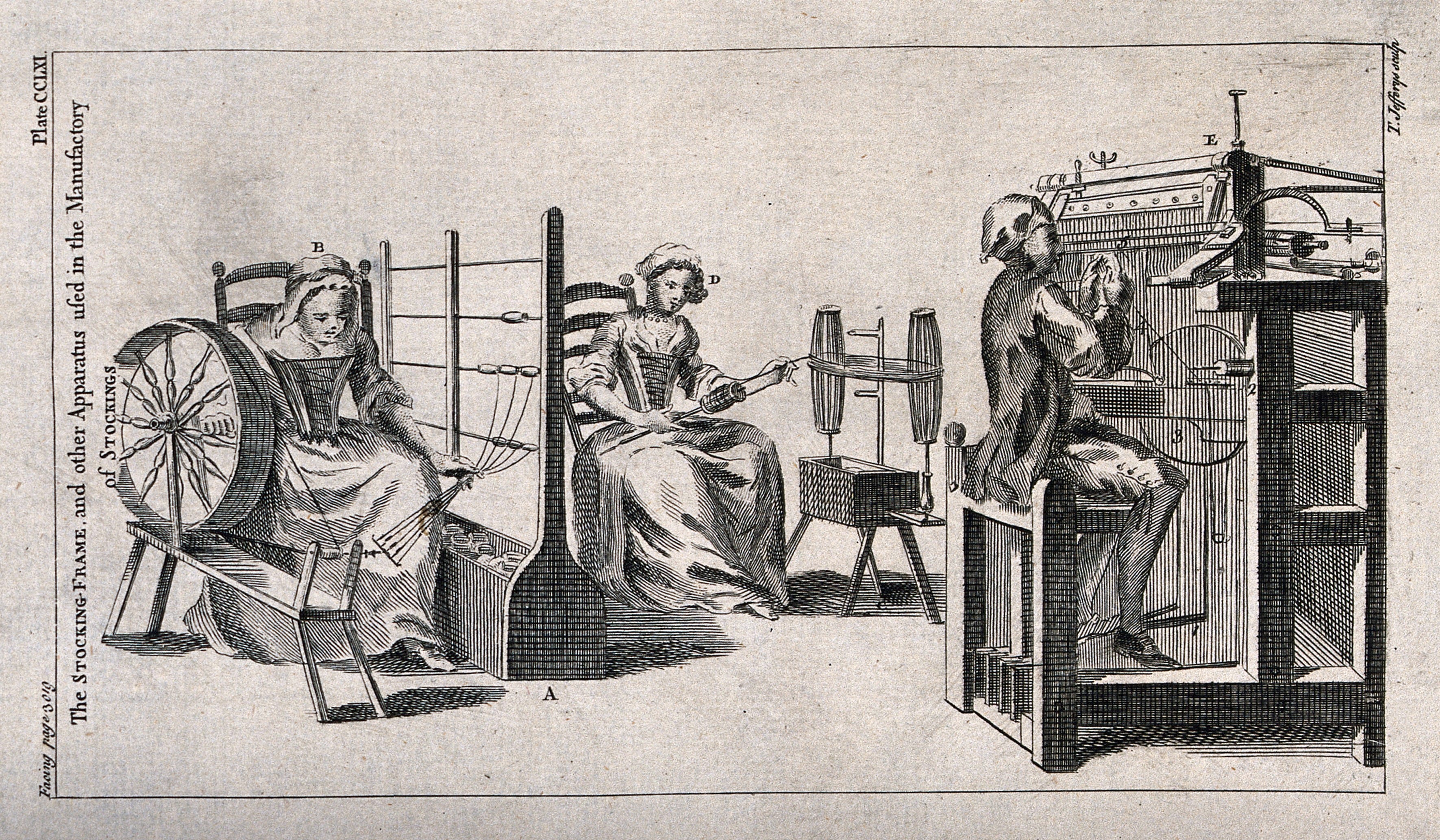
It also fitted easily around domestic life, which made it difficult to replace. Knitting requires very little equipment, it is portable, and it can be set aside without much loss. It had always been done alongside other work: tending animals, managing a household, filling the long winter evenings. Across most of Britain, for most of this period, knitting was a regular part of running a household rather than a seasonal or marginal practice.
* * *
Structural reasons explain why knitting was not industrialised in the same way as spinning and weaving. Why hand knitting survived as a widespread domestic practice when hand spinning did not is a separate question, and more a matter of cultural history than economic history.
Spinning was useful and universal, but as it moved into factories, there was no longer any reason to teach it to people who did not need it, and it carried no particular social value that might have kept it alive in homes where it was no longer economically necessary.
Knitting, for most of its history, had been much the same: a form of paid labour or household necessity, unglamorous and widespread. By the Victorian period, knitting had become a respectable leisure activity for women of the middle and upper classes, done in drawing rooms and at social gatherings. In Victorian society, “useful” needlework was valued as a visible expression of feminine virtue and respectability, and a publishing industry grew up around it: pattern books, magazines, instructions for increasingly elaborate work. The knowledge was actively circulated to people who came to it for pleasure rather than necessity. At the same time, knitting was being taught in workhouses and charitable schools, to orphans and the poor, as a skill that could generate a modest income. It functioned simultaneously as a polite accomplishment and as a form of poor relief, and both uses kept it in circulation.
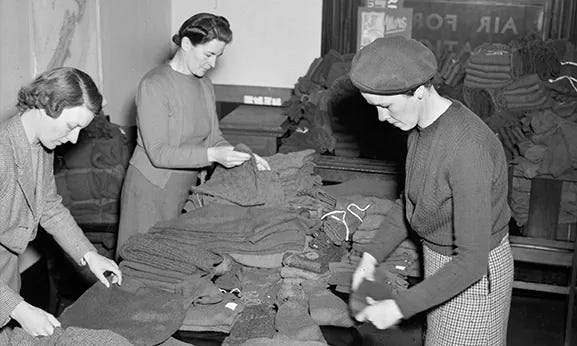
Wars gave people further reasons to knit, starting in the 1850s with the Crimean War, where women were encouraged to send “templar hoods” or “helmet liners” to the front, which eventually became known as “balaclavas”, named after the site of an important battle. Both world wars also produced large-scale civilian knitting campaigns, with millions of people producing clothing and equipment for troops. The campaigns were organised, publicised and backed by social pressure, and they kept many people knitting through periods when it might otherwise have declined.
None of those reinforcing mechanisms existed for spinning. By the time the factory had made domestic spinning unnecessary, there was nothing to sustain it.
* * *
Crochet’s story is quite different from knitting’s, despite the crafts sharing many similarities.
Its origins are disputed: some trace it to Europe in the early nineteenth century; others argue for older roots. What is clearer is that by the mid-nineteenth century, it was popular in Britain and Ireland both as a hobby and as a way of supplementing income through lace-like work. Queen Victoria crocheted and reportedly gave away items she had made, which gives some sense of how fashionable it had become at the highest levels of society.
Where crochet’s story diverges most clearly from knitting’s is in its relationship to machines. Knitting was eventually industrialised: the flat-bed and circular machines that produce most knitted fabric today are true knitting machines, reproducing what hand knitting does at an enormous scale. Crochet has not been mechanised in the same way. Machines that produce crochet-like fabric typically do so using knitting technology, imitating the look rather than reproducing the construction. Crochet is formed from a single active loop, continuously manipulated with a hook, and that motion has complications for industrial automation.
Crochet was never industrialised at all, partly because by the time it became widespread, the textile machinery already in existence had been built around different processes, and there was no obvious incentive to start again from a different direction.
* * *
Most knitted fabric today is made in factories. The circular machines that produce jersey and the flat-bed machines used for shaped knitwear are largely automated, part of the same global supply chain that the textile revolution created. The industrial version of knitting is real and here to stay.
Hand knitting has continued alongside it. I have written before about how, even with a knitting machine, I would not stop knitting by hand, because the two scratch very different itches. That difference is probably why hand knitting survived: there was always a reason to keep doing it, and enough people across enough generations kept passing that reason on.
Further reading
The history of hand knitting, V&A: a broad overview of knitting’s development, from medieval guild workers to the present day.
Knitting for Victory, The History Girls: on the organised wartime knitting campaigns, from the Crimean War through to the Second World War.
Knitting and domestic life, Victorian style, Modern Daily Knitting: on knitting as a respectable drawing-room accomplishment in the nineteenth century,and the publishing economy it produced.
The framing of knitting as having "survived" rather than been "preserved" is the right one — it locates the craft in households rather than institutions, which is where its real durability lived. There is a parallel in Japan with sashiko: it persisted not because it was protected but because it was useful, portable, and quietly social, sat in alongside other evening work. Once a technique can be set down and picked up again in any room of the house, it tends to outlast the systems that would replace it. The crafts that disappear, in my experience, are the ones that required a dedicated setting.
Maybe hand knitting continued because knitters could make items for themselves and their families, whereas hand spinning didn’t in the same way because it was done to provide yarn or threads for someone else to use.