


I have been spending time trawling through old newspaper archives recently, searching for references to knitting, and a clear pattern keeps appearing. In the court reports and workhouse notices, in the charity school announcements and the occasional death notice, the craft rears its head in the same confined corners. The knitters in almost every case are drawn from the same dustbin of history that so many of us would have likely found ourselves in: poor, dependent, and without many options. Knitting is presented as something people do at the edges, rarely as a pastime or a pleasure, which is not the story most of us have heard about the craft.
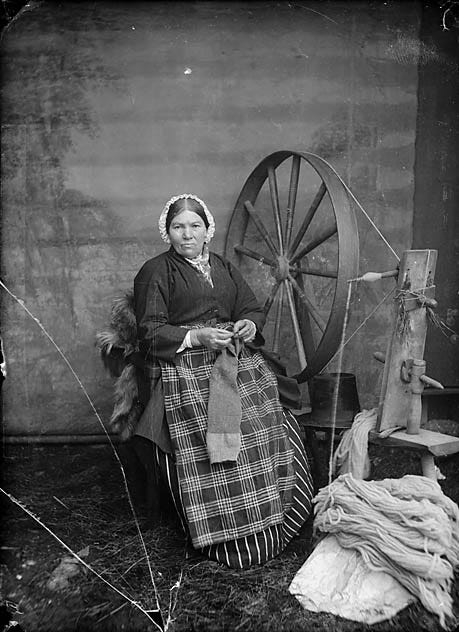
The growth of hand knitting in England is closely tied to changes in fashion and in the economy. In the second half of the 16th century, men started wearing breeches and as a result knitted stockings came into fashion. There was demand at almost every level of society, and most of it was met by the poorest workers. Knitting had the advantage of requiring almost no capital outlay: a set of needles, a ball of yarn, and whatever light and time was left at the end of a working day. It could be done while watching livestock, walking to market, or tending a fire. By the end of the 16th century, historian Joan Thirsk estimated there were as many as 220,000 hand knitters in England, comprising roughly thirteen per cent of the pauper class.
A few censuses of the poor survive from the period, and Lesley O’Connell Edwards, whose research on working hand knitters from the 16th to the 19th centuries is an excellent account of this world, draws on these. In Norwich in 1570, fifty-eight of 860 poor women surveyed earned all or part of their living through knitting; 72 of the 926 children in the same survey did too. In Ipswich in 1597, ten women listed it as their sole income. Alongside the poverty, though, the censuses record something else: knitting was a skill that had to be taught, often formally, rather than something everyone already knew. The Ipswich survey records four children listed as ‘goeth to knitting schole.’ They had to be sent somewhere to learn it. The assumption many knitters carry now, that the craft has always passed naturally from hand to hand across generations, is not well supported by the historical record. In 16th-century Britain, knitting was still relatively new, and it had to be deliberately taught.
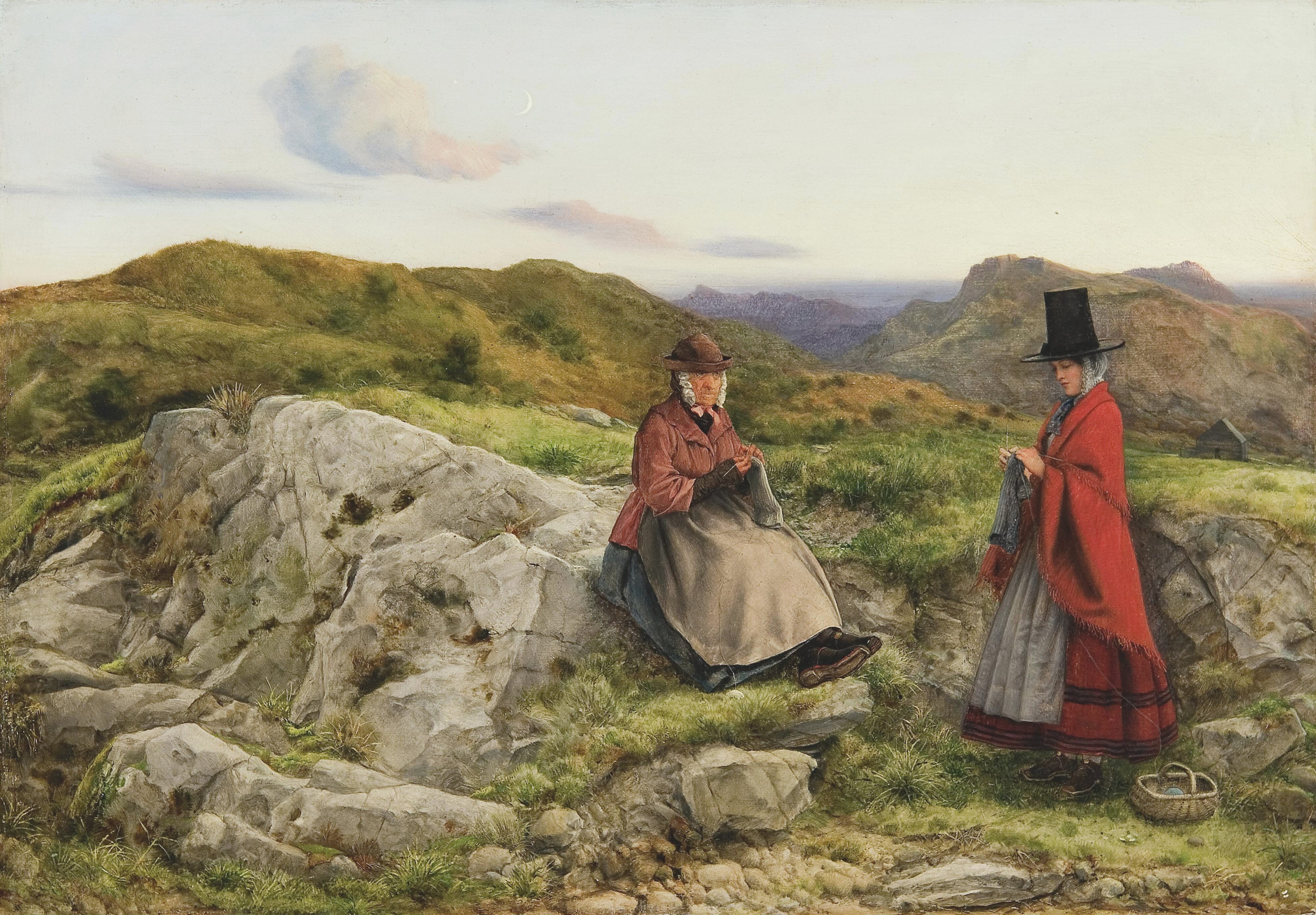
From the late 16th century onward, civic institutions and charitable donors set up formal arrangements to teach knitting to the poor. Over a hundred such establishments have been traced in England alone. The knitting school in York, one of the earliest, was running by the 1590s with a master and overseers teaching thirty scholars at a time. Thomas Firmin, writing in 1678, proposed that parishes fund schools to teach poor children to spin and knit stockings, not for the children’s benefit, but to prevent them from becoming a burden on the parish. David Davies, writing over a century later in 1795, complained that parishes which neglected to put the poor to work had allowed knitting and spinning to fall out of fashion even in cottages, with mothers no longer capable of passing the skills on.
The Factory Acts of the 1830s required mills employing children to provide some schooling, and the same priorities can be seen in the curriculum of those mill schools. One owner told a government inspector that teaching girls to sew and knit would be ‘of quite as much or more advantage than the mere learning to read.’ The children’s work was expected to cover, or at least contribute to, the cost of schooling. In the Kirkdale Industrial Ragged Schools, reported on in the Liverpool Mercury in 1859, over three hundred children of ‘the lowest class of inhabitants’ attended daily. Boys were taught shoemaking and knitting; girls, knitting and the making of clothing. The school was growing and needed larger premises. The benefit to the children was presented as self-evident, since the children were now off the streets and regularly attending church.
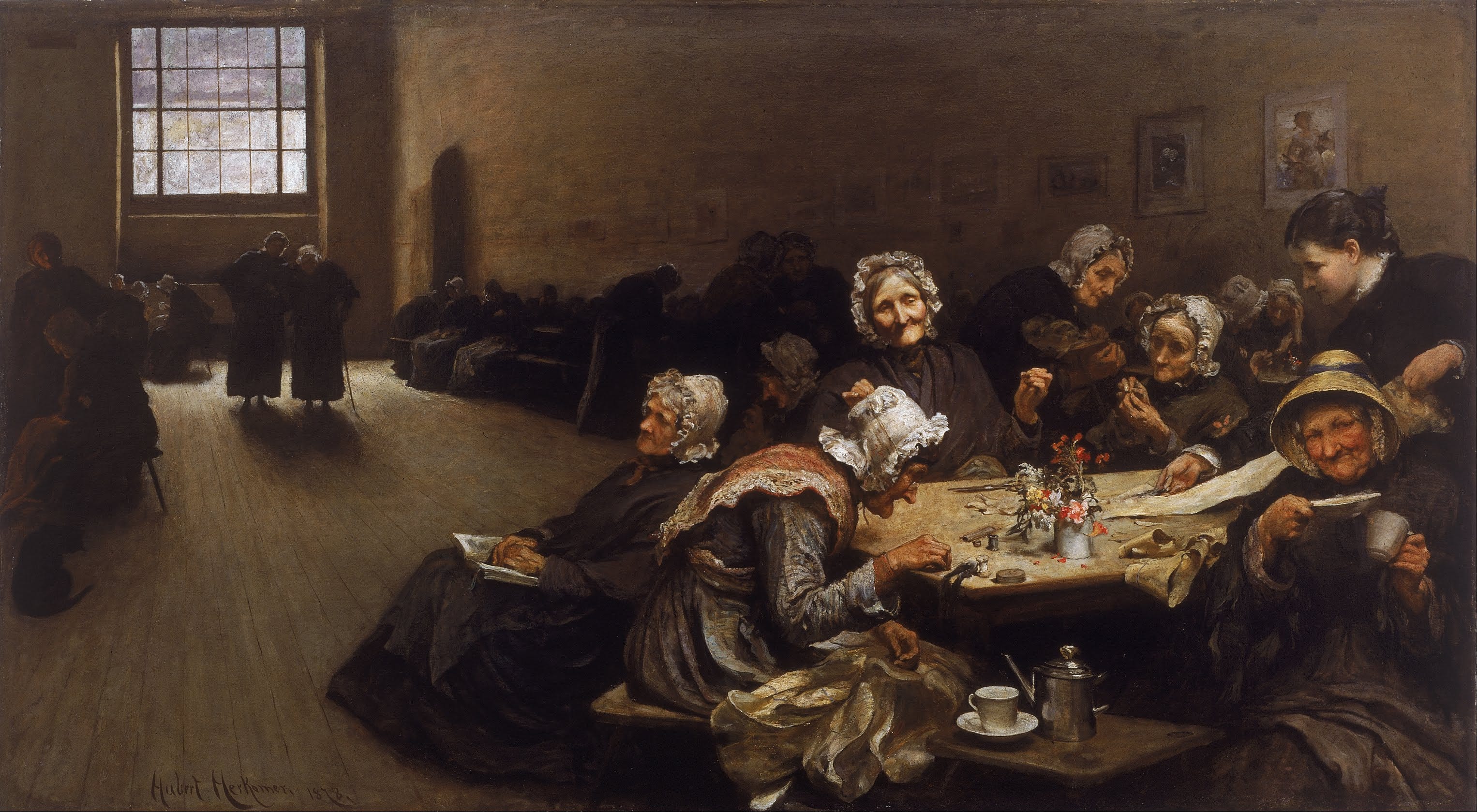
After the Poor Law Amendment Act of 1834, the scale of institutional provision grew considerably. The union workhouse system that replaced locally administered poor relief became notorious for its conditions. Knitting was part of the labour expected of women and children inside. At the Gressinghall House of Industry in Norfolk, young women employed in knitting received two pennies from every shilling they earned, a sixth of their wages, with the institution keeping the rest. The work was not intended to generate significant revenue. The stated rationale was moral: knitting built habits of industry and virtue in people who had otherwise fallen into idleness.
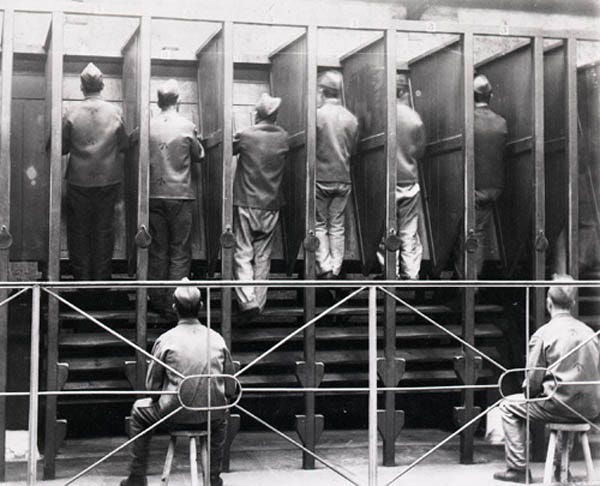
An 1823 Liverpool Mercury article arguing against the use of the treadmill as prison punishment contains an image of what this looked like in practice. The writer describes visiting a private asylum and observing one of the inmates, a woman whose assigned employment was knitting stockings. She had been working on a single stocking for several months without ever finishing it. When the writer saw it, it was several yards long, and there was no prospect of it ending. ‘If the mind of the unfortunate lady be not changed,’ the article notes, ‘and if her keepers have not interfered, it may, by this time, be as many miles long.’
The article’s actual argument is about the treadmill: condemning a sane person to the same kind of endless, purposeless work is as cruel as what illness has done to this woman. The writer clearly finds both troubling, but I think the image is also revealing about the institutional thinking behind it: occupation without purpose or product, for people who could not be trusted with idleness. The endless stocking is that thinking carried on with nothing to interrupt it.
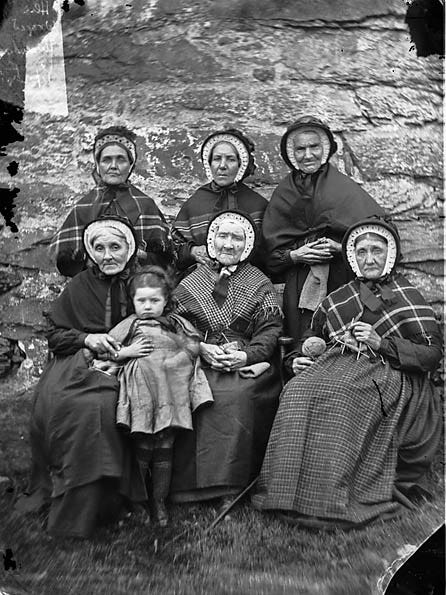
Not all knitting at the margins was institutional. Jane Cooper spent more than fifty years selling knitted stockings and gloves from a basket to the nobility and gentry travelling the Great North Road between London and Scotland. She was a fixture of the coaching route, well known as the Old Fat Stocking Woman, and many a duke and lord became her regular purchasers. When the railway was built and the coaching traffic stopped, her trade was finished. She died in May 1851, aged 86, at the union workhouse in Kirkby Stephen.
Her life and the lives of the institutional knitters were very different, but they ended in the same place. She could live from knitting while the economic conditions held, and not once they changed. What she had that the workhouse knitters did not was fifty years of choosing her own hours, setting her own pace, and selling to her own customers.
What knitting meant to the people inside those institutions is hard to recover. What the authorities thought it meant is well recorded: work, discipline, a small supplement to the accounts. The people sitting knitting in workhouse wards and charity schools left almost nothing behind. Most of the surviving evidence comes from the people running the institutions rather than those inside them.
My own experience of knitting as a last resort was nothing like theirs. I came to it at a point when my physical health had seriously declined, and I was adjusting to new challenges. Knitting turned out to be a way back into the sense that I could still learn something new, still make something, still find real pleasure in spending time with myself. No one assigned me the task, and I was not in an institution. But the possibility that some people in those workhouses and charity schools found something similar, even under coercion, some small space in a situation that offered very little, seems worth keeping open. Knitting can be a last resort, but at the same time, a new beginning.
Modern prison programmes that offer knitting to inmates are justified in therapeutic rather than productive terms. The argument now rests on mental health and wellbeing rather than virtue and character, but the underlying claim, that making things helps people in difficult situations, has been made for a long time.
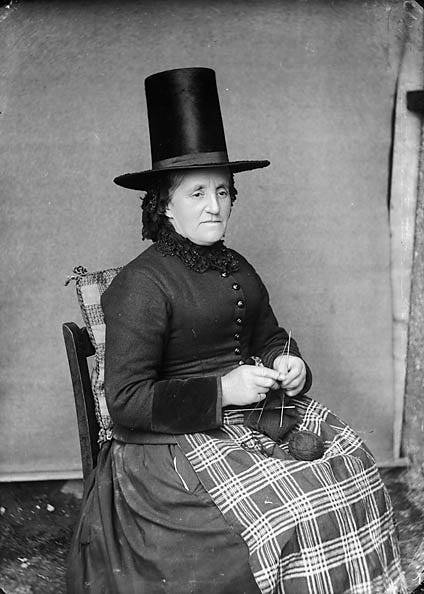
Over its history, knitting has been a survival industry, a moral discipline, a form of wartime solidarity and a chosen leisure activity. For most of the period in which it was widespread, it was work: unglamorous, poorly paid, done out of necessity by people who had few alternatives. By the Victorian period it had simultaneously become a respectable drawing-room accomplishment and a form of compelled labour in institutions.

The people in the 16th-century censuses, the knitting schools, the workhouses, could never have imagined knitting as something done by choice, for pleasure, yet they are probably the people we have to thank for it.
Further reading
Lesley O’Connell Edwards, ‘Working Hand Knitters in England from the Sixteenth to the Nineteenth Centuries’, Textile History, 41:1 (2010), pp. 70–85: A detailed account of knitting as paid labour, drawing on census records, charity school archives, and workhouse accounts.
Meg Gomersall, ‘Woman’s Work and Education in Lancashire, 1800–1870’, History of Education, 18:2 (1989), pp. 153–162: Broader context on women’s labour and education in the industrial period, and on the overlapping assumptions behind both.
Liverpool Mercury:
28 October 1859 — Kirkdale Industrial Ragged Schools
25 February 1858 — Asylum for Orphan Boys
6 June 1823 — the endless knitting / treadmill essay
20 May 1851 — obituary of Jane Cooper, the Old Fat Stocking Woman
Louise Tilbrook, ‘She didn’t knit for fun’, Everyday Knitter: An amusing personal rebuttal to the claim we should aspire to ‘Have the kind of summer your grandmother would recognise’.
Thanks for sharing such an inspiring piece of history. I certainly recognize the hard work you put into researching and writing this article.
Thanks for your fascinating article. I'm a neurologist by day, knitter by night. obviously I do not knit out of financial desperation. I knit for pleasure and mental health. I find it relaxing and therapeutic. I also enjoy the end product.
I taught both my girls to knit and spin. I also taught elementary school students how to spin. We made our own drop spindles out of a dowel rod and weighted disc. This only cost a few pennies to make. I can see how this could be a source of income for the impoverished. Although it may have been a task of drudgery or necessity for many, I still think people derived a sense of purpose and value from doing these apparently menial tasks. I certainly do.