


This issue is almost entirely about spinning: my first linen yarn and the nålbound bag I am making from it, the last breeds from the sample box, and the plan for my first gradient yarn, a Cheviot spin for a crochet shawl.
Spinning Linen
My first linen yarn is off the wheel: 100 g of flax, plied into a loose 2-ply of around 330 m per 100 g. The shop listed it as “combed top” linen, though the description was in Finnish and I am not completely sure what that translates to in English. From the long, smooth fibres, I think it was line flax. I spun it on the Wee Peggy without a distaff or any special setup, treating it much like the wool I had been spinning, except that I spun the singles S, the opposite direction from my usual wool.
I am not suggesting a beginner should start with flax, but I found it much easier than wool for understanding what twist and drafting actually are. With wool, the drafting triangle can feel like a fuzzy haze that suddenly turns into yarn. With flax, because the fibres are so long, I could see individual strands go from untwisted to twisted as they ran into the yarn. Partway through I switched to spinning wet, dampening the fibre as I drafted, which smoothed down the hairiness and was much kinder to my hands.
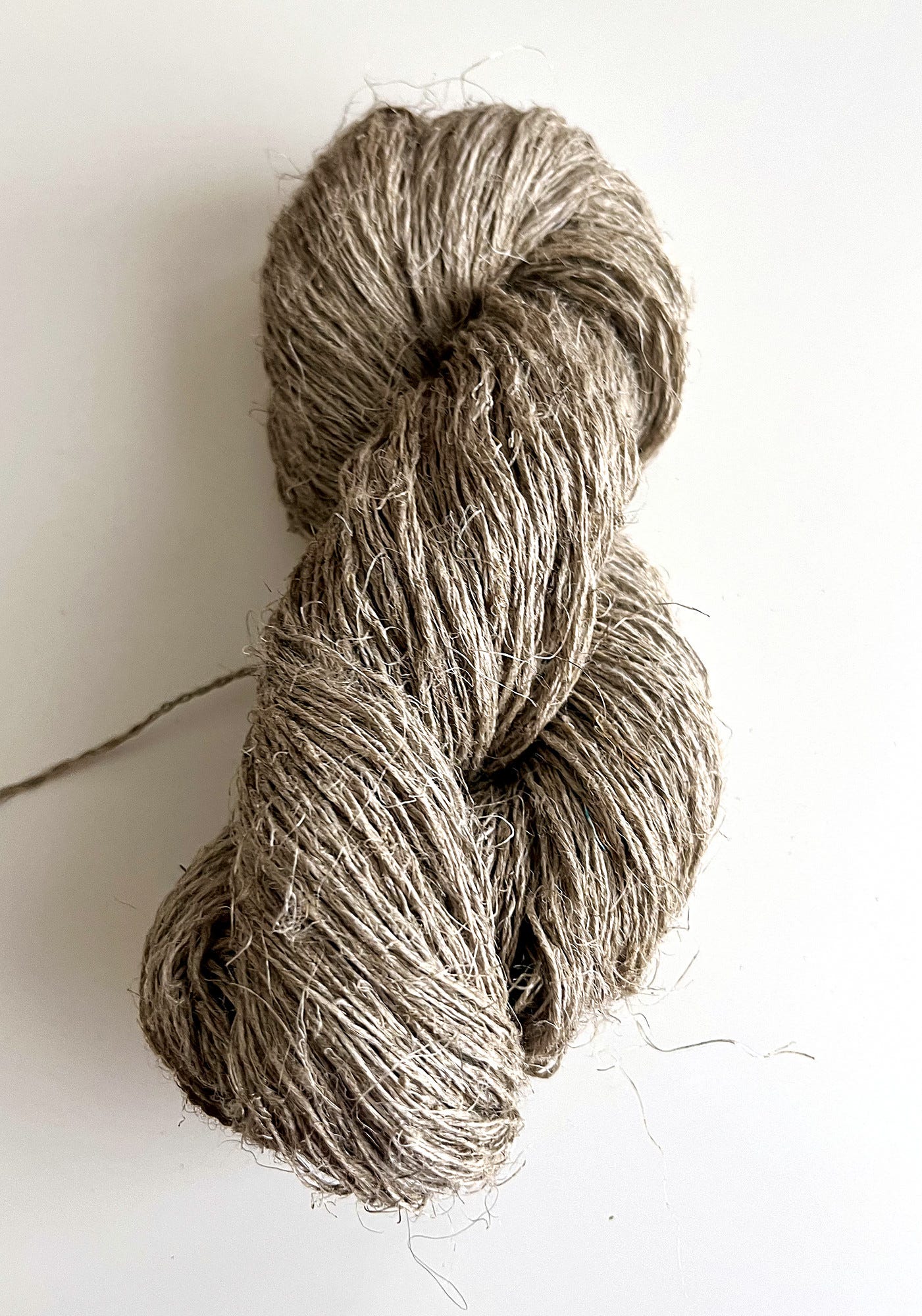
I found the whole process deeply meditative, to the point where my mind and body felt at one with the wheel. When I was looking for a wheel, most of the secondhand ones for sale near me were old Nordic flax wheels, so it felt fitting to spin some flax myself, even if mine is a wheel from New Zealand. Although I would not associate flax with Finland today, it was grown here from around the 11th century, and from the 18th century until the mid-20th century it was one of the most important crops in the country. Before the 20th century, most rural households had their own spinning wheel and loom, and the textile work was mainly done in winter, outside the farming season.
