


Before the stocking, a quick thank you: this newsletter passed 1,000 subscribers this week. When I started writing here in April, I didn’t expect so many people to want to read about sock heels and knitting sheaths, so thank you for being here.
The Victorian stocking has finally reached the heel. For anyone just catching up, this is the “Gentleman’s Striped Stocking” from the 1886 Weldon’s Practical Stocking Knitter, knitted without the stripes in Garthenor Snowdonia on 1.5 mm DPNs, at roughly 11.5 stitches per inch (46 stitches in 10 cm).
I started it in July with four questions in mind: what a 19th-century stocking was like to knit at the gauge the pattern asks for, whether a knitting sheath made any difference, how a Welsh heel is actually worked, and whether anyone really could knit one stocking on the walk to market and the second on the way home.
The Leg
By my count, the leg alone came to about 35,000 stitches. One of my usual socks is around 10,000 stitches in total, about 5,000 of them in the leg, so this single leg was equivalent to 3.5 whole socks, or seven of my usual sock legs.
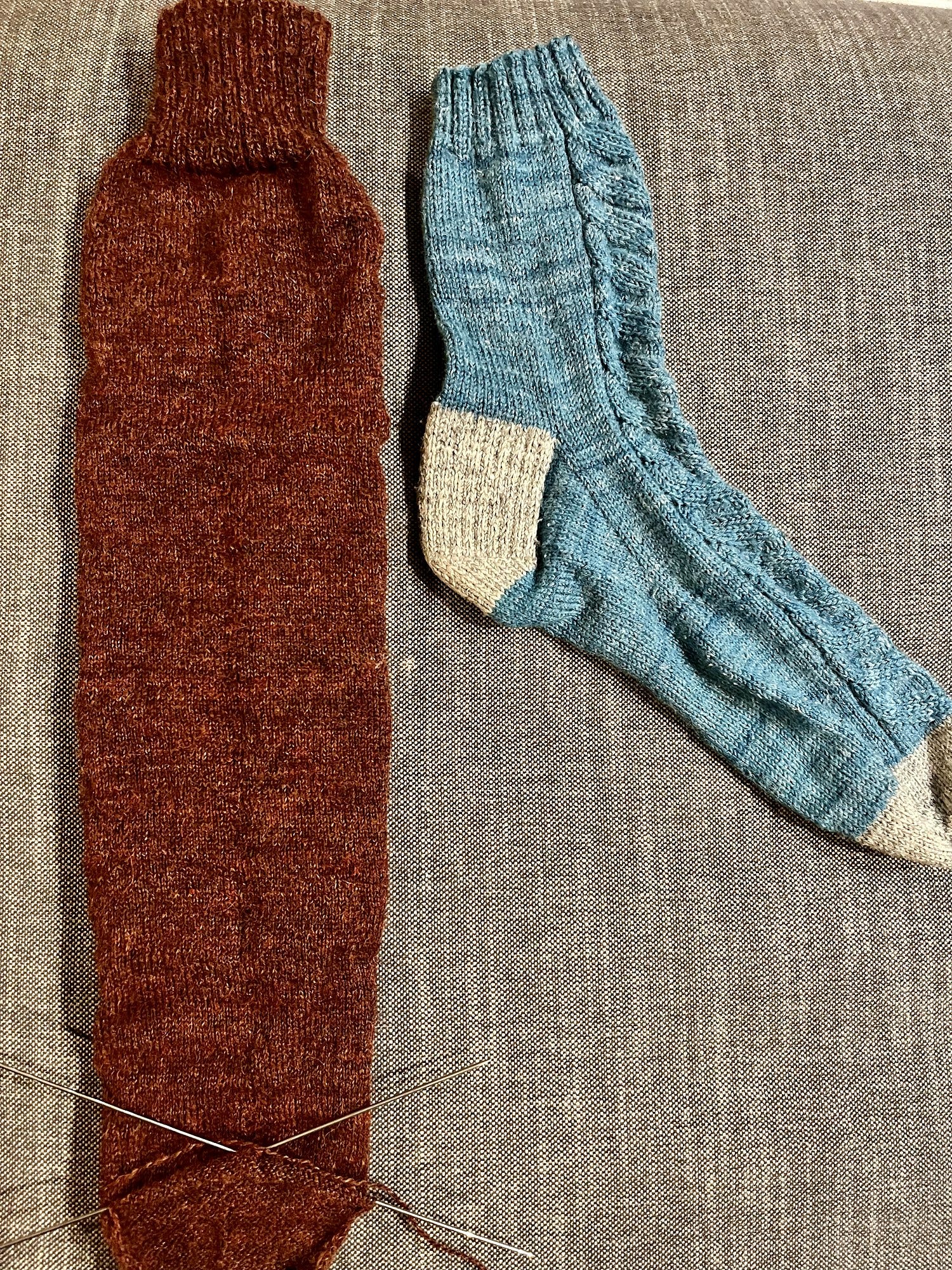
I wrote about the seam stitch a few issues ago: a single purled column marking the start of the round. It is meant to work rather like a stitch marker, but in practice I kept knitting straight past it. I eventually solved this by purling that one stitch the Eastern way. When I knit ‘Continental’ style, I use the combination method, so my purls are wrapped from front to back and my knits from back to front. One of the things I love about this method is that knit and purl patterns are very easy to keep track of: the two kinds of stitch feel different as I come to them, so I rarely need to look at my work and I make fewer mistakes.
I was knitting this stocking ‘English’ style, where my knits and purls feel the same as I come to them. I realised that if I purled the seam stitch the Eastern way, that one stitch would feel different in the same way. My style was therefore English with Western-mounted stitches for 99% of the stocking, and English with an Eastern-mounted stitch for the seam stitch. It sounds convoluted, but from then on I stopped missing the seam stitch.
