


In September 1867, the West Derby workhouse board in Liverpool opened an inquiry into its assistant matron, Miss Moss, on charges of insubordination brought by the governor, Mr Goode, and the matron, Mrs Cutts. One of the charges: crocheting during meal breaks in the dining hall. Knitting, everyone at the inquiry seemed to agree, would have been fine.
Goode had called her into the lobby one day and asked whether she thought the dining hall was a proper place for “fancy work.” She told him it was, and that she had no intention of letting him “tyrannise” over her. What made the charge stick, or almost stick, wasn’t the craft itself. In the paper’s own words: “The other female officers were allowed to knit stockings, and the male officers to read books and talk together, but it was only Miss Moss who was accused of insubordination.”
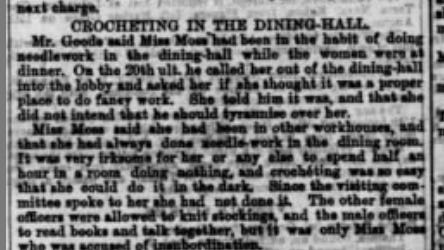
Knitting stockings, plain and useful, made for people who needed clothes, was fine, even for officers on duty. Crochet counted as “fancy work,” and was treated as inappropriate for that reason alone. Men talking and reading wasn’t insubordination at all. The charge was never really about whether her attention was divided while she worked. It was about which kind of divided attention a person was allowed to have, and that seems to have depended on what you were making and who you were.
By the end of the hearing, a resolution calling the whole list of charges “frivolous,” and asking Miss Moss to resume her duties and work amicably with the master and matron, passed by 12 votes to 8, which presumably felt like a real blow to Mr Goode. It wasn’t a clean win, though. She didn’t get permission to keep crocheting, and the whole ordeal was a reminder that in 1867, it was in a woman’s best interest to do as her male superiors said.
The crocheting charge was only one of several brought against her that day: whether she’d searched new arrivals at the lodge properly, whether the men had clean shirts, who’d said what about whom to which guardian. Partway through, Goode complained that Miss Moss had been going round telling guardians he was a poor governor. “All I can say is that she has been held out as a terror to me,” he said, and the room laughed at him. Other guardians called the charges “pettifogging.” Even the chairman, trying to keep order, allowed that gentlemen might call them pettifogging, but insisted they were still charges of insubordination all the same.
Miss Moss’s own defence was that she’d always done needlework in the dining room, in every workhouse she’d worked in, and that spending half an hour sitting there doing nothing was irksome to her or anyone else. Crocheting, she said, was so easy that she could do it in the dark. She’d already stopped, once the visiting committee had raised it with her weeks before, so by the time of the inquiry the whole argument had become somewhat circular and reads to me as if Miss Moss was being singled out.
Technically, the charge against her was disobedience, not craft. Miss Moss had been told what was and wasn’t appropriate by a superior, and carrying on regardless is what had got her in trouble. But crochet wasn’t picked at random. Knitting stockings was common, useful, and already part of the workhouse’s own economy: residents knitted them too, partly to bring in income for the institution. Crochet was a newer craft, only a few decades old in Britain by 1867.

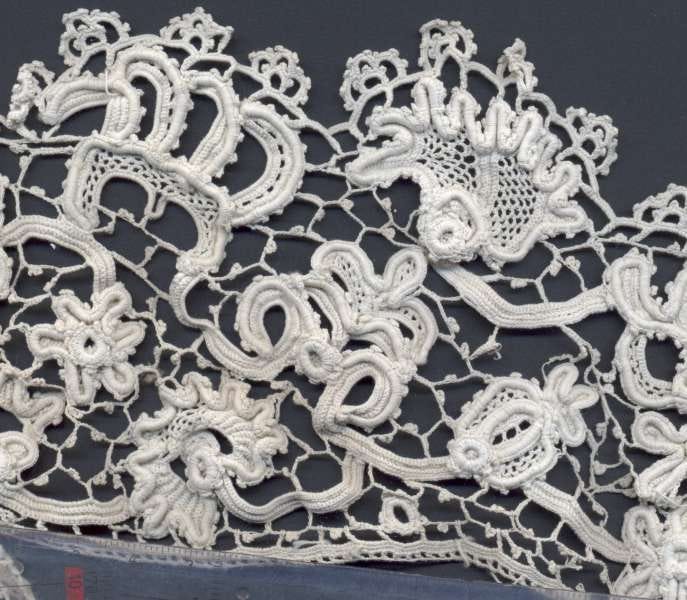
It also carried two quite different reputations depending on who was holding the hook. Among the upper classes it was a genteel accomplishment, a way to show off skill in the drawing room. Among the poor, Irish crochet lace had become a fast, cheap way to imitate expensive Venetian point lace for sale, a trade that grew directly out of famine-era relief work, especially relevant since Liverpool was home to many such refugees. Goode’s “fancy work” complaint could have been drawing on either reputation: that it was leisure-class needlework with no business in a dining hall, or that Miss Moss was making something to sell, on the institution’s time, for her own profit. Unfortunately the report doesn’t make clear which he meant, but he had no doubt it was inappropriate.
Her explanation resonates with me today, and if I was ever challenged on my knitting I’d probably say something similar. Crocheting was so easy for her that her hands didn’t need her eyes or her attention to keep going, which created space in her mind, something people who don’t craft probably find hard to understand.

The hierarchy of crochet against knitting still crops up as a discussion online, though the Victorian context behind it has mostly disappeared. Most non-crafters nowadays see them as a single category of yarn-related hobbies, something people do in their free time, for fun. Our brains like to categorise things and quickly assess people by their clothes and items around them. A laptop open in a meeting reads as diligence, whether the person behind it is taking notes or scrolling through Facebook reels on mute. It’s an object we associate with work, even when it’s being used as a distraction. A ball of colourful sock yarn, on the other hand, instantly stands out as an item that doesn’t belong in the workplace, even when it’s acting as the key to absorbing the information actually being presented.
I think about this every time I’m traveling for work. This past week I’ve been at a large international conference, which means hours a day in an auditorium listening to talks that are fascinating, if highly specialised. I struggle to pay attention no matter how interesting I find them, and my instinct is to pull out my phone and start scrolling. I’m not alone in this: half the room is on their phones or laptops, some replying to emails or working on documents, but plenty on Facebook or tabloid news sites. I can’t read and listen at the same time, so if I’m on the Wikipedia page for the 13th-century Tavastian Uprising, I’m probably not absorbing the talk on structural phylogenetics.
To combat this, I now take my knitting to events like this, and I’m often seen in work meetings knitting away on a sock. Amongst my close colleagues this is no problem; they know I’m a better listener and contributor with my hands busy, and often I’m not the only one. But on international trips like this, networking with peers as well as leaders in my field, I sometimes feel like my knitting reads as unprofessional. A laptop, whether or not there’s any work being done on it, doesn’t get the same look.
Back in the auditorium, none of Goode’s actual objections apply to me. Nobody’s checking whether I searched anyone at the lodge. My sock isn’t going to be sold for a profit I’m hiding from a board of guardians. There’s no superior standing over me telling me to put it away. All that’s really left of the 1867 complaint is the most nebulous accusation: that it doesn’t look like work. Miss Moss had to prove herself against a governor with a grudge and a long list of charges. I doubt I’ll ever be in a situation like that. But the confusion on people’s faces when they see me knitting tells me some things don’t change.
Further Reading
“A Squabble at the West Derby Workhouse,” Liverpool Daily Post, Thu 19 Sept 1867, p. 9.
“Irish Crochet Lace: 150 Years of a Tradition,” Lacis Museum of Lace and Textiles.
Thank you for this wonderful story! My grades in college all went up when I started knitting and crocheting in class -- taking notes and participating in class discussion all the while! Dr. Nancy Rodman, sometimes called "Mother of the Hubble Space Telescope" was famous for knitting during NASA meetings to help her pay attention (my mother, who also worked on the Hubble, told me she witnessed this firsthand!) But I think the distinction between useful knitting and fancy crochet is telling. I still struggle to have respect for my own crochet lace work.
This is terrific! As a lifelong crocheter who learned how to knit in mid-life, I stick a bit to the American assumption (I think) that crochet is for the working class. And knitting for those who can afford the fancy material to work with. Thanks for this—just love it!