



I had been keeping an eye on Chase Harpole’s Earthbound for a couple of months and had set my mind on casting on this spring. It is a seamlessly constructed, top-down sweater in sport weight yarn, with wide, even stripes reminiscent of a classic rugby shirt. What drew me to it beyond the look was the sizing: forty adult sizes grouped by shoulder width rather than chest measurement. Shoulder width is, in my experience, the dimension that matters most for a good sweater fit, and seeing it taken seriously from the start was immediately appealing.
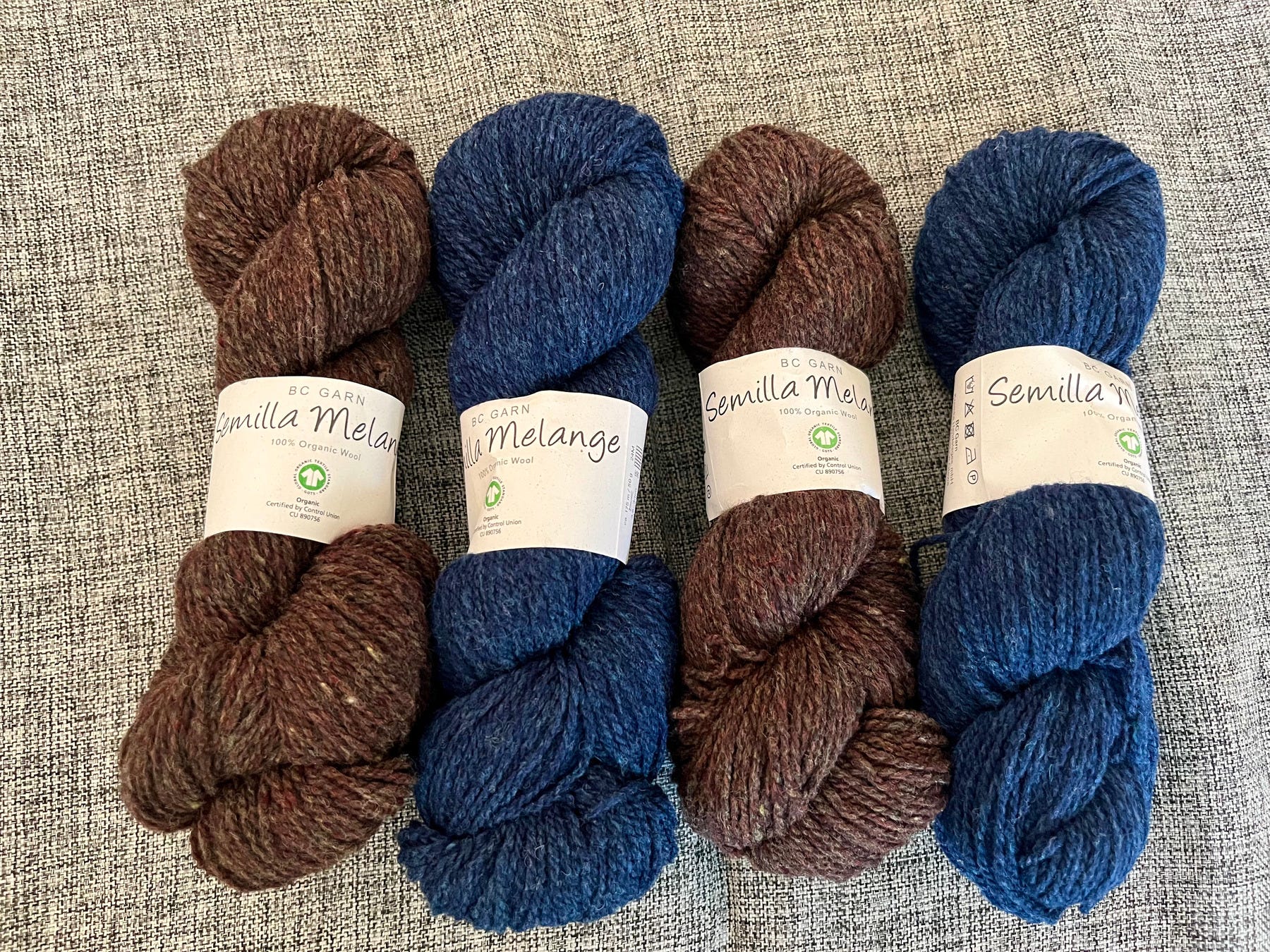
I had also been dreaming about a wool I’d seen at my local yarn store. Semilla Melange from BC Garn is a woolen-spun sport weight yarn that comes in a refined selection of muted colours. There were two colourways I couldn’t stop thinking about: a deep chocolate and a dark navy, both shot through with small flecks of orange and red. Fazer, Finland’s most popular chocolate brand, uses a similar navy in its packaging, and I’d always thought the chocolate looked particularly chic when peeking out of the packaging. The pattern and yarn seemed to belong together, and everything was on track for it to be on my needles as the snow was melting.
Then, in mid-March, I ended up getting a knitting machine. I previously wrote about how this was something I never thought I’d get into, but it somehow just happened. After a few simple hats, pairs of socks, and a slightly more advanced lace scarf, I decided it was time to tackle a sweater on the machine. My plan was to ease myself in with something simple: a drop shoulder sweater, worked in pieces, bottom up. No unusual construction, no conversion work, just learning the machine’s habits before adding complexity. This is a reasonable approach for a beginner, so of course I abandoned it almost immediately, and decided I would make Earthbound on the machine and work out the adaptations as I went.
The problem was that it is a seamless, top-down design with set-in sleeves, intended for hand knitting. Working in the round isn’t possible on a single-bed machine, and seamless top-down construction isn’t something I had seen instructions for in machine knitting. Still, I decided it was better to make a sweater I truly wanted than something just for the sake of it. So, away I went, overly confident and perhaps a bit naive.
After six swatches (yes, you read that correctly) I still couldn’t match the pattern’s gauge on my machine. I settled on the fabric I liked best and decided to recalculate the instructions from the schematic rather than keep chasing the original gauge. This also gave me the opportunity to customise the dimensions to my own body rather than choosing the nearest graded size. I took careful measurements and worked through the arithmetic, checking each section against the schematic. The previous time I had trusted a size chart over my own measurements, I ended up with sleeves 10 cm too long. Although I had more confidence in the designer this time, I realised that nobody’s body neatly fits into any one box, and in my case the arms appear to be the significant outlier.
Rewriting the pattern into my spreadsheet (running totals, row-by-row increases, calculated widths and lengths at each stage) was where I encountered something unexpected. The back yoke depth was considerably shorter than the front. I had never seen this in a hand-knitting pattern before and spent some time working out what it meant.
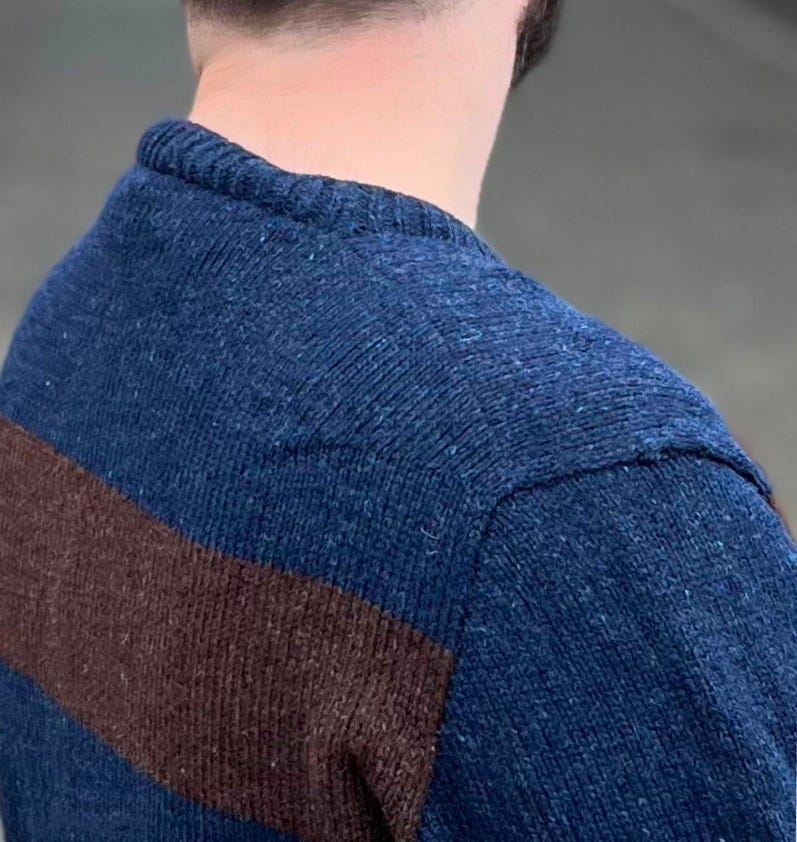
The construction goes by several names, among them European shoulders, English tailoring, and fully fashioned shoulders. The terminology is not consistent, and the sources I found do not agree on what distinguishes one term from another. “European Shoulder Seam” appears to be a relatively recent coinage used as an umbrella for what is variously called English, Italian, or French seams, all of which describe the same basic principle: placing the shoulder seam on the back of the shoulder rather than on top. The front piece carries no shoulder shaping at all and just runs straight across. When the garment is assembled it torques naturally into position over the shoulder. This seems like it shouldn’t work, but the more I thought about it, the more it started to make sense.
This method has its origins in commercial knitwear, with the motivation being efficiency. Concentrating all the shoulder shaping on one piece meant that the other piece could be knitted without any shaping at all, making it extremely efficient. The resulting shoulder seam ends up sitting on the scapular spine, which is said to be where it should be for an anatomical fit. Designers had taken that industrial tradition and brought it into a hand-knitting pattern, and I was then taking it back to a machine. If anyone has a clear source on the distinctions between the different terms for this construction, it would be great to know.
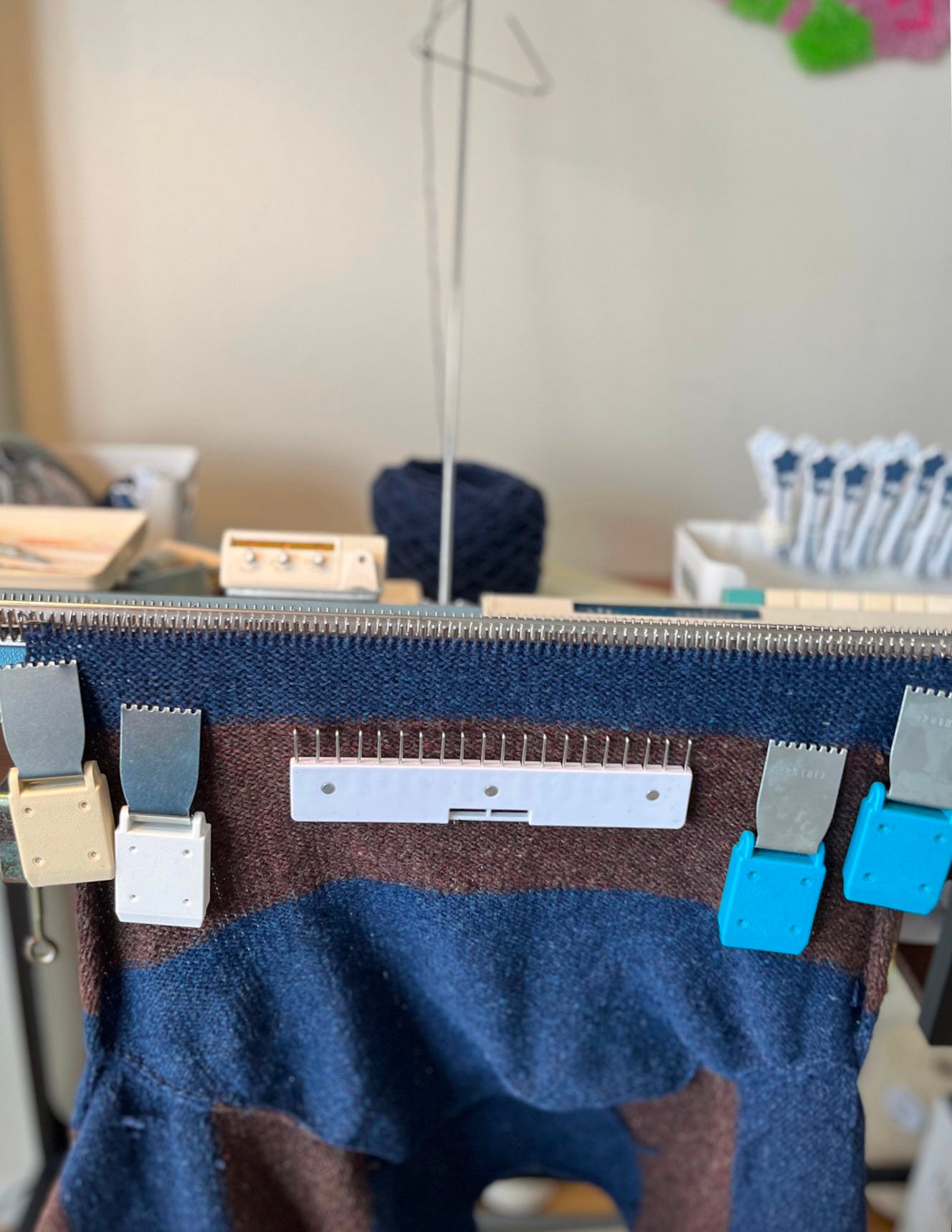
I sat down at the machine the morning after finishing the spreadsheet, planning to get most of the sweater done over the weekend. The top of the back yoke begins with short rows, which on a machine require the fabric to be weighted evenly below the needle bed. Directly after a cast on there is very little fabric to hang weights from. After a couple of false starts I found a solution: cast on with waste yarn first, knit a couple of inches, then work a crochet cast on onto that base. The waste yarn gives enough fabric to attach weights, and once the short rows are done the knitting proceeds cleanly.
The pattern also includes a contrast-colour detail on each sleeve cap, worked in short rows using a small section of intarsia. I had bought a second-hand intarsia carriage for exactly this kind of work, but it was still in the UK. Working the intarsia section by hand while also managing short rows felt like too many variables to track at once, so I left the detail out. It had been one of the things I loved most about the pattern, and dropping it was a bit of a disappointment. The sleeves look fine without it, and I’m glad I made the decision to simplify things slightly.
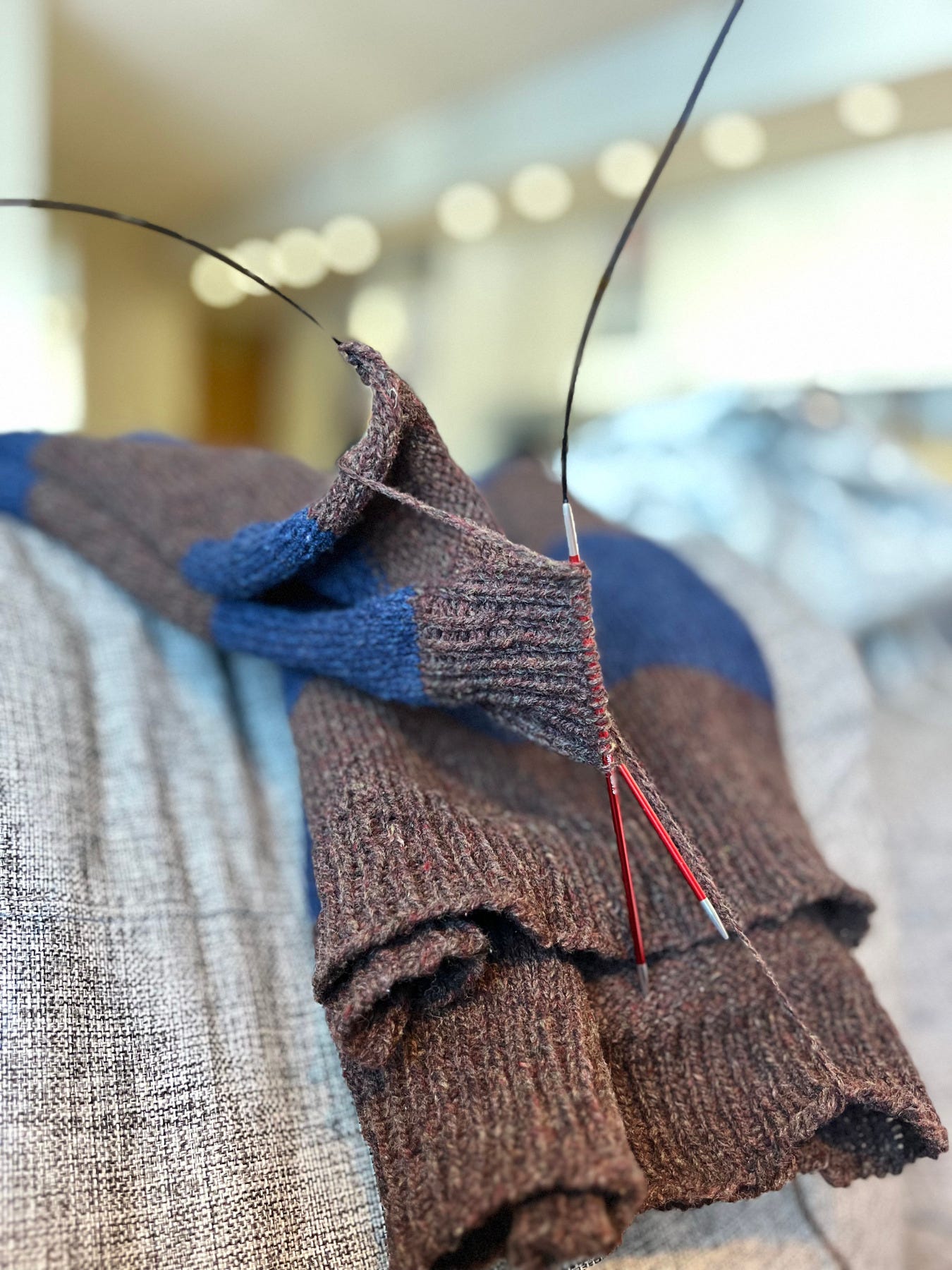
After those early obstacles, the knitting itself moved quickly. Each sleeve took about an hour on the machine, which makes the case for second-sleeve syndrome quite weak. Seaming and the collar followed without drama. The overall ease was, I think, a product of how the pattern was written: the instructions are clear enough that converting them, while involved, was mostly a matter of working carefully through what was already there. A well-written pattern is one you can adapt.

I have decided it is the best sweater I have ever made. The fit is better than anything previous, partly because I calculated the dimensions to my own body rather than selecting from a chart. The stripes are exactly what I hoped. The Semilla Melange is soft enough to wear against the skin, something I wasn’t certain of until the fabric was blocked and fully relaxed.
The week after finishing it, I wore it on a day out at Seaton Sluice with family. There is something different about wearing a new sweater through a full afternoon outdoors with people who know you well, compared to putting it on for a day home alone. That afternoon is when it started to feel finished.
The European shoulder construction is something I want to try again moving forward. I hadn’t come across it before this project, and now that I understand what it does, I can see myself applying it in future work regardless of whether the original pattern calls for it. The fit across the shoulders is the part I am most pleased with.
I plan to make the next machine-knit sweater in flat pieces, closer to how the machine is typically used. I may come back to Earthbound in hand knitting at some point. For now, the result was better than I had any right to expect from a project I entered by ignoring all of my own advice.

FURTHER READING
Pattern: Earthbound by Chase Harpole
Yarn: Semilla Melange by BC Garn
On European shoulders and fully fashioned construction:
- “Zen Inspirations: The European Shoulder Seam” — East London Knit (2016). Good introduction to the construction and how it came to be named.
- “Full Fashioned Shoulders” by Leslie Gonzalez — TKGA. This covers the history, the mathematics of shoulder slope, and why the seam sits where it does.
Love your yarn choices! So cool to make something that you can wear.
It turned out lovely! It’s interesting how you have taken the technique back to machine knitting.
I recently discovered European shoulders too. I couldn’t believe when I read there is nothing to be done on the front.
Oh I also saw it referred to as Japanese shoulders - the origin remains obscure to me as well. 😅
I’m a big fan of Chase’s work. So happy to have come across your machine interpretation.